
Friends of CHEDDAR/Industry 2026: Research Posters
4 Jun, 2026

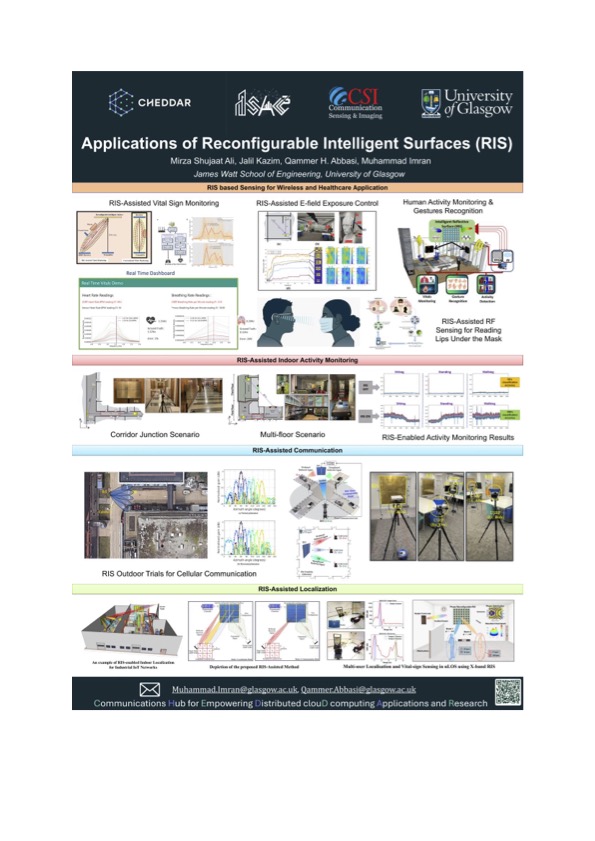
Applications of Reconfigurable Intelligent Surfaces
Mirza Shujaat Ali, Jalil Kazim, Muhammad Imran and Qammer H. Abbasi
This research shows how RIS can improve wireless coverage while supporting sensing, localisation and environmental control. Applications include vital-sign monitoring, activity recognition, non-line-of-sight localisation and more efficient future 6G networks.
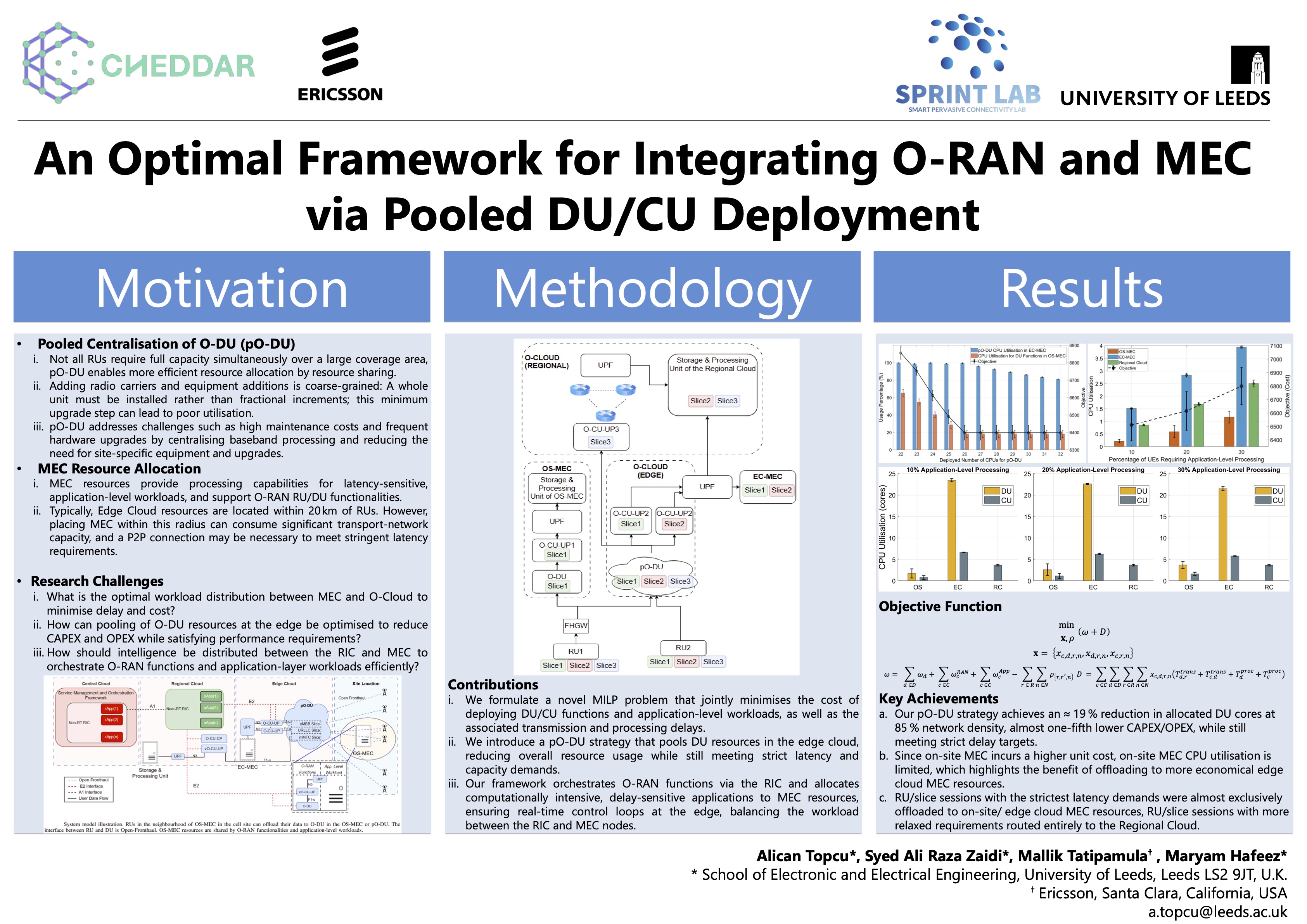
An Optimal Framework for Integrating O-RAN and MEC via Pooled DU/CU Deployment
Alican Topcu, Syed Ali Raza Zaidi, Mallik Tatipamula and Maryam Hafeez
This research presents a cost-aware framework for integrating O-RAN with edge computing. By pooling network resources and optimising workload placement, it could reduce unnecessary provisioning while maintaining latency and capacity requirements.
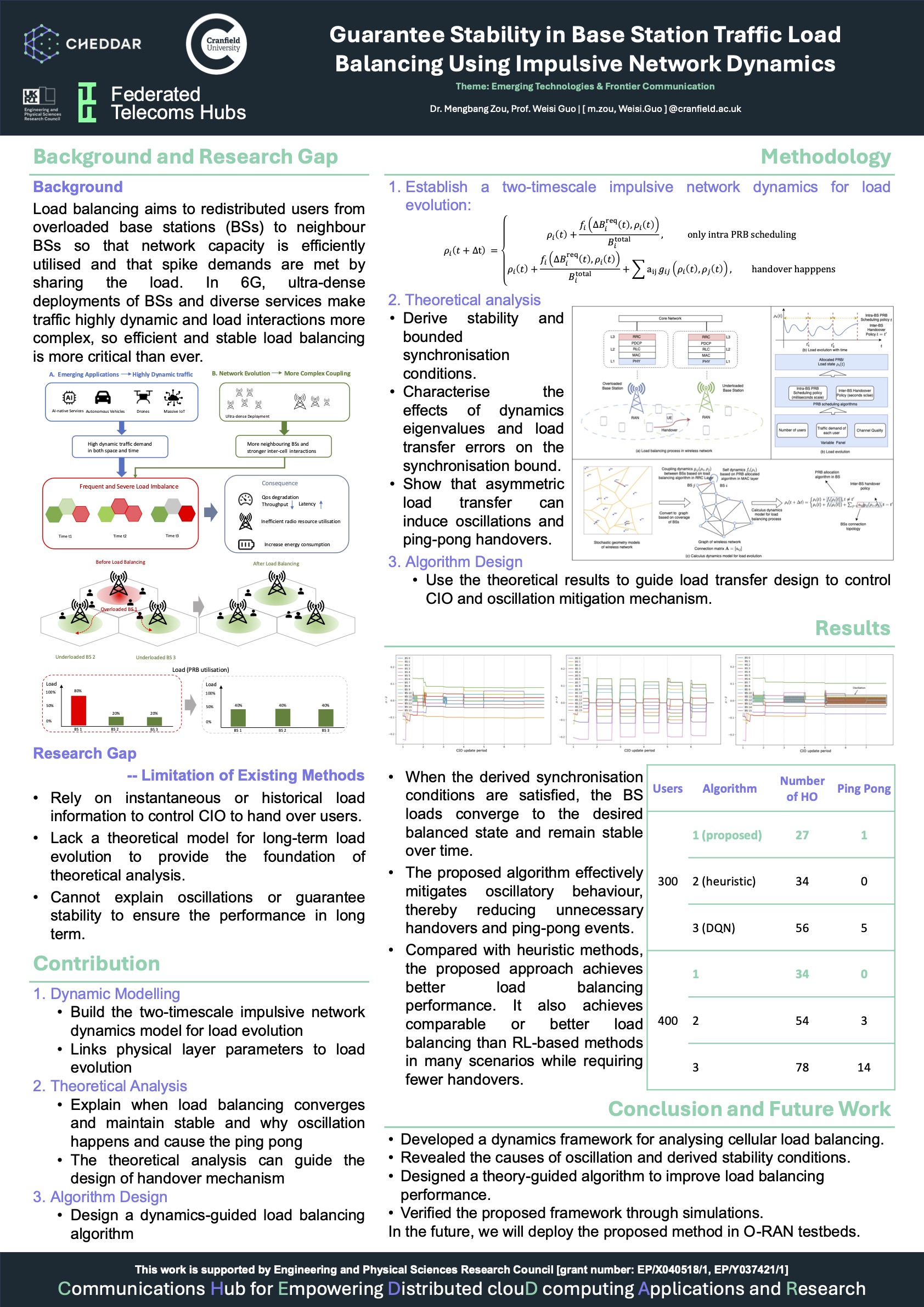
Guarantee Stability in Base Station Traffic Load Balancing Using Impulsive Network Dynamics
Dr Mengbang Zou and Professor Weisi Guo
This research models how traffic moves between base stations in dynamic 6G networks. By capturing scheduling and handovers across multiple timescales, it supports stability analysis and the design of trustworthy AI-native load-balancing systems.
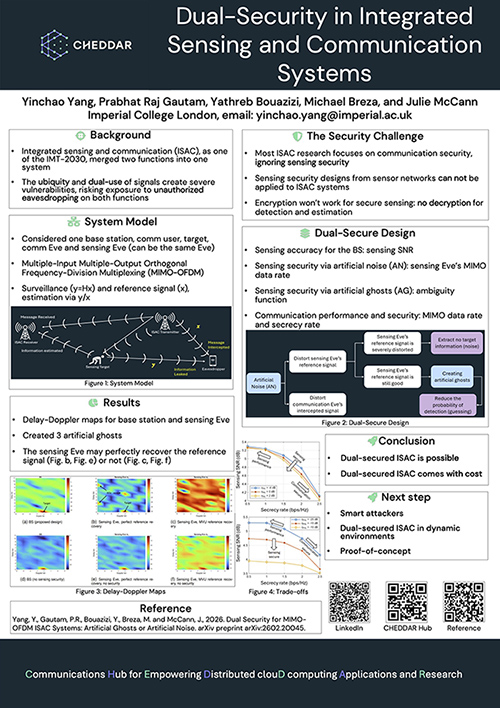
Dual-Security in Integrated Sensing and Communication Systems
Yinchao Yang, Prabhat Raj Gautam, Yathreb Bouazizi, Michael Breza and Julie McCann
This research strengthens security in ISAC systems by protecting both communications and sensing. It uses artificial noise and false targets to mislead sensing eavesdroppers while maintaining communication secrecy, supporting more secure and resilient future 6G networks.
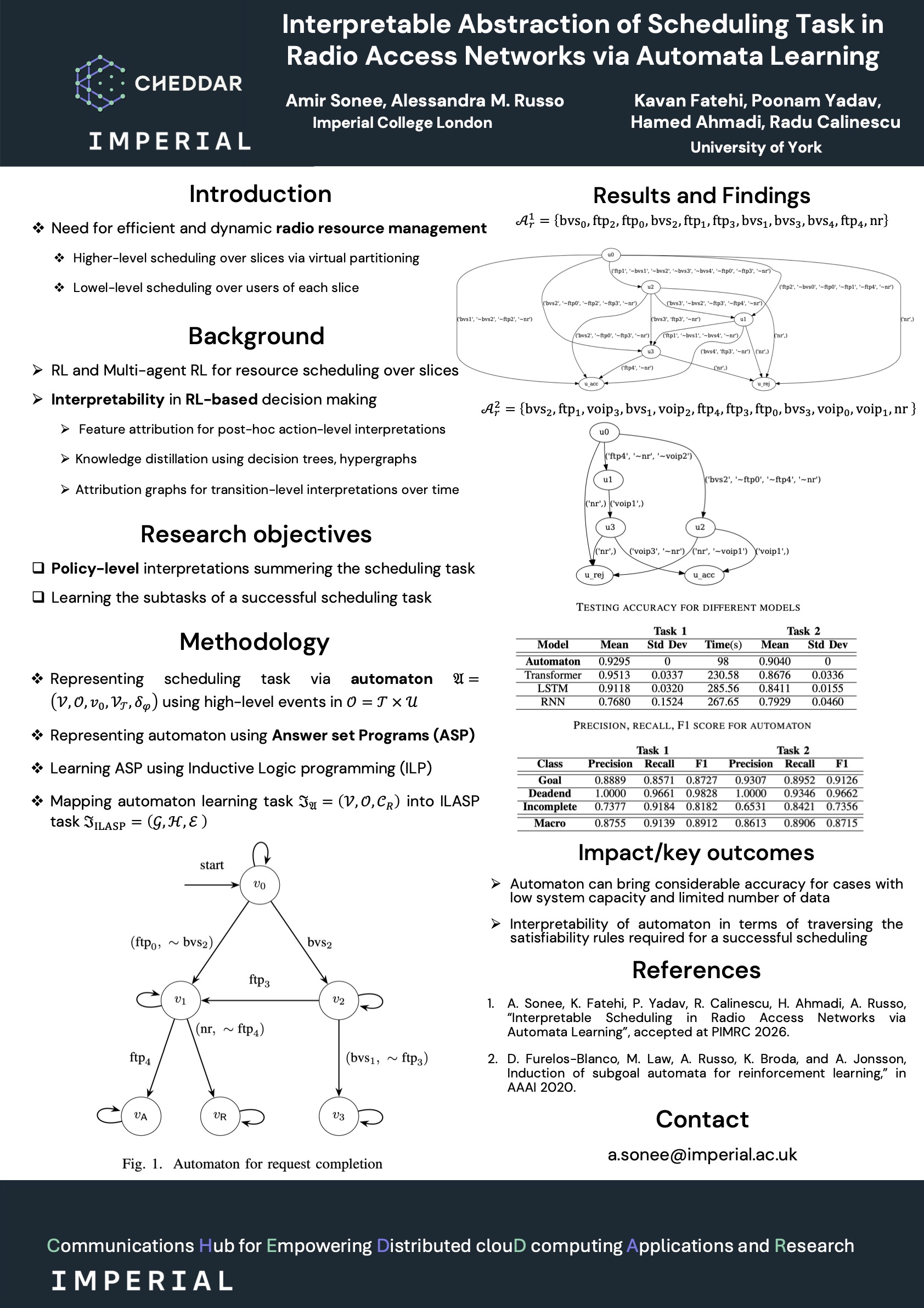
Interpretable Abstraction of Scheduling Task in Radio Access Networks via Automata Learning
Amir Sonee, Alessandra M. Russo, Kavan Fatehi, Poonam Yadav, Hamed Ahmadi, Radu Calinescu
This research uses an interpretable automaton model to allocate radio resources and fulfil service requests in RAN. It performs similarly to more complex sequential models while making scheduling decisions easier to understand, and could support future reinforcement-learning-based optimisation.
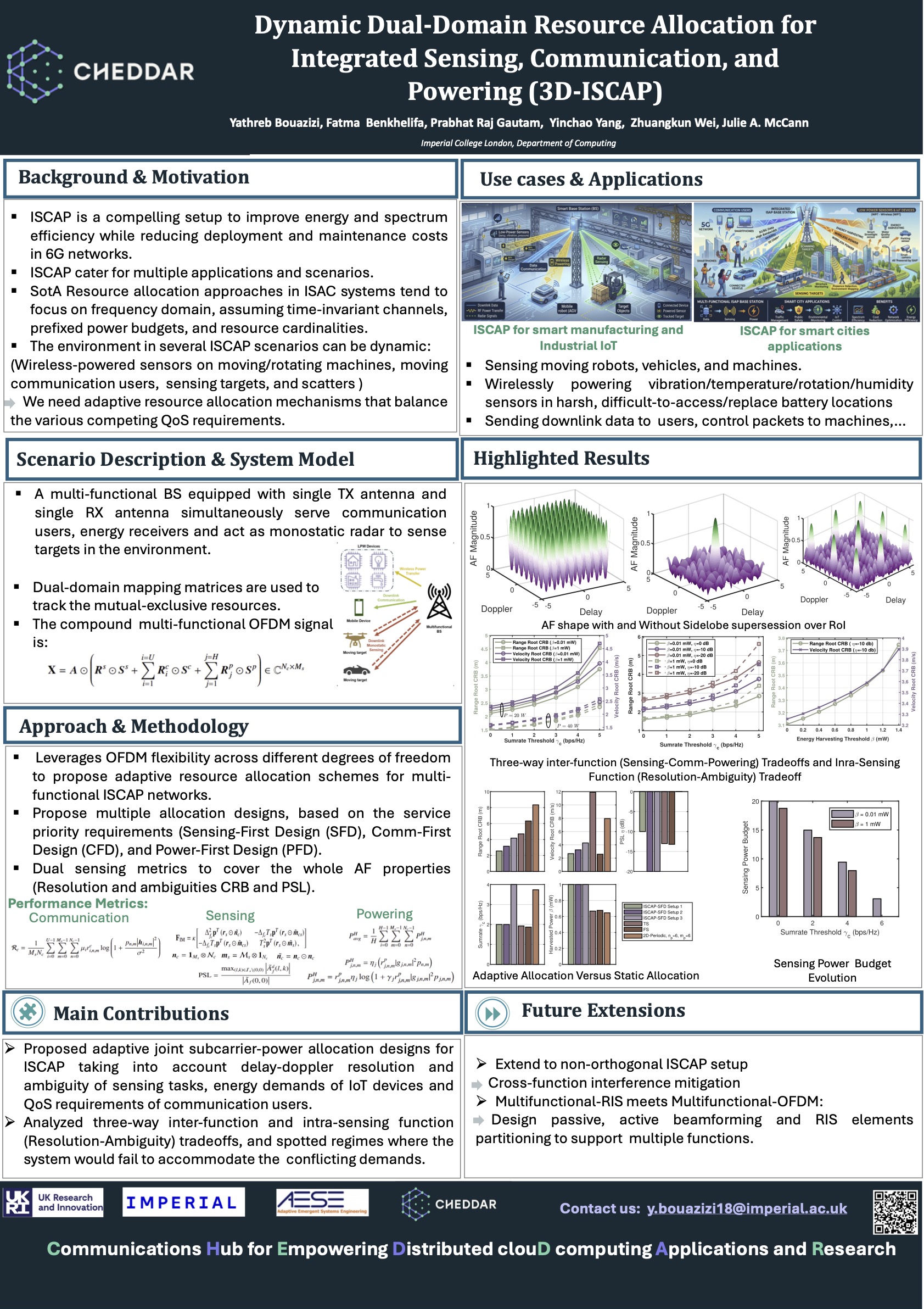
Dynamic Dual-Domain Resource Allocation for Integrated Sensing, Communication and Powering (3D-ISCAP)
Yathreb Bouazizi, Fatma Benkhelifa, Prabhat Raj Gautam, Yinchao Yang, Zhuangkun Wei and Julie A. McCann
This research develops adaptive systems that combine sensing, communication and wireless power for smart cities, manufacturing and industrial IoT. It examines how to balance sensing accuracy, device energy needs and communication performance in dynamic environments, while identifying when competing demands cannot be met.
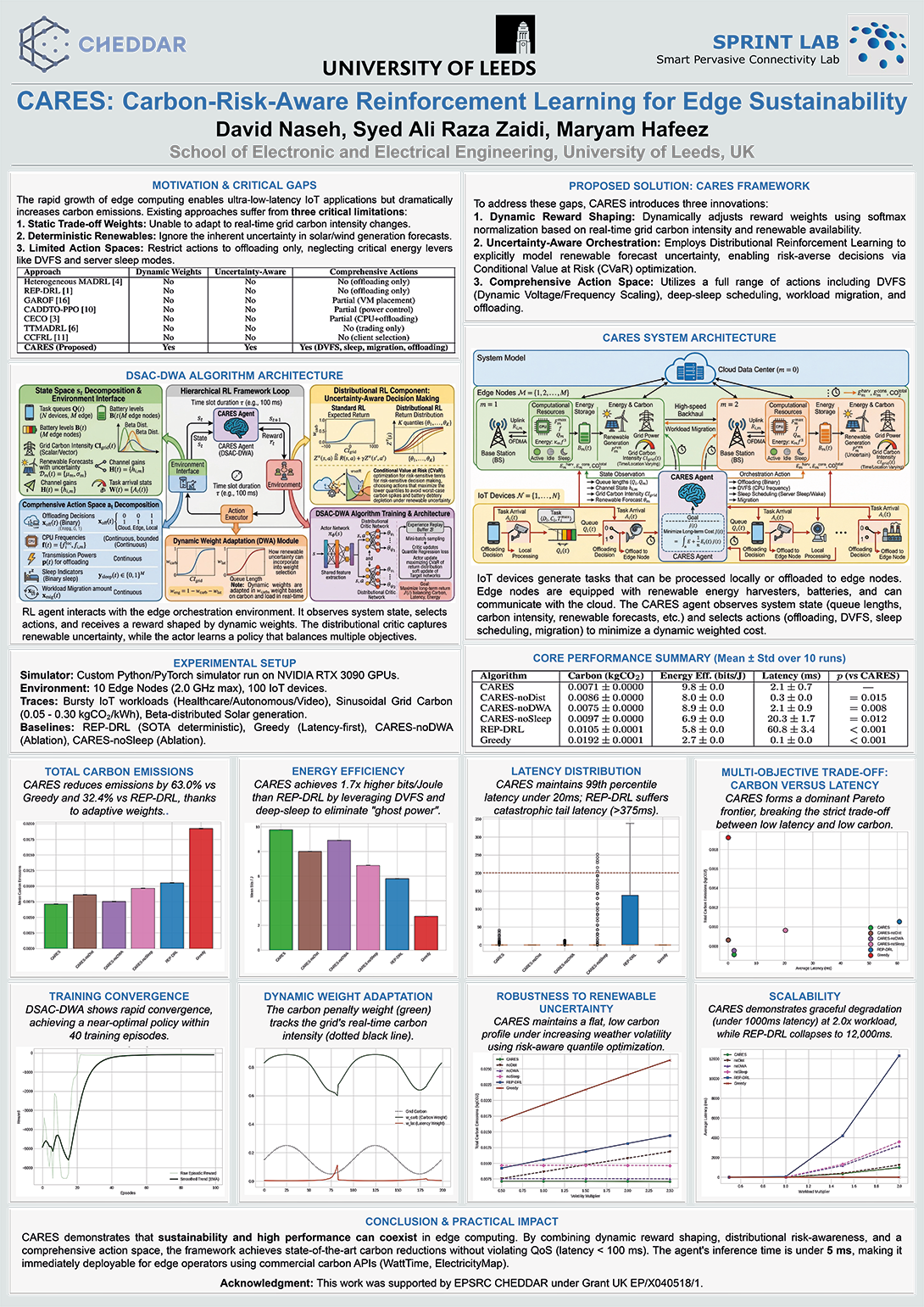
CARES: Carbon-Risk-Aware Reinforcement Learning for Edge Sustainability
David Naseh, Syed Ali Raza Zaidi and Maryam Hafeez
CARES uses risk-aware AI to reduce carbon emissions from edge-computing systems while maintaining fast, reliable processing. It cut emissions by 63%, improved energy efficiency by 1.7 times and kept latency below 20 milliseconds.
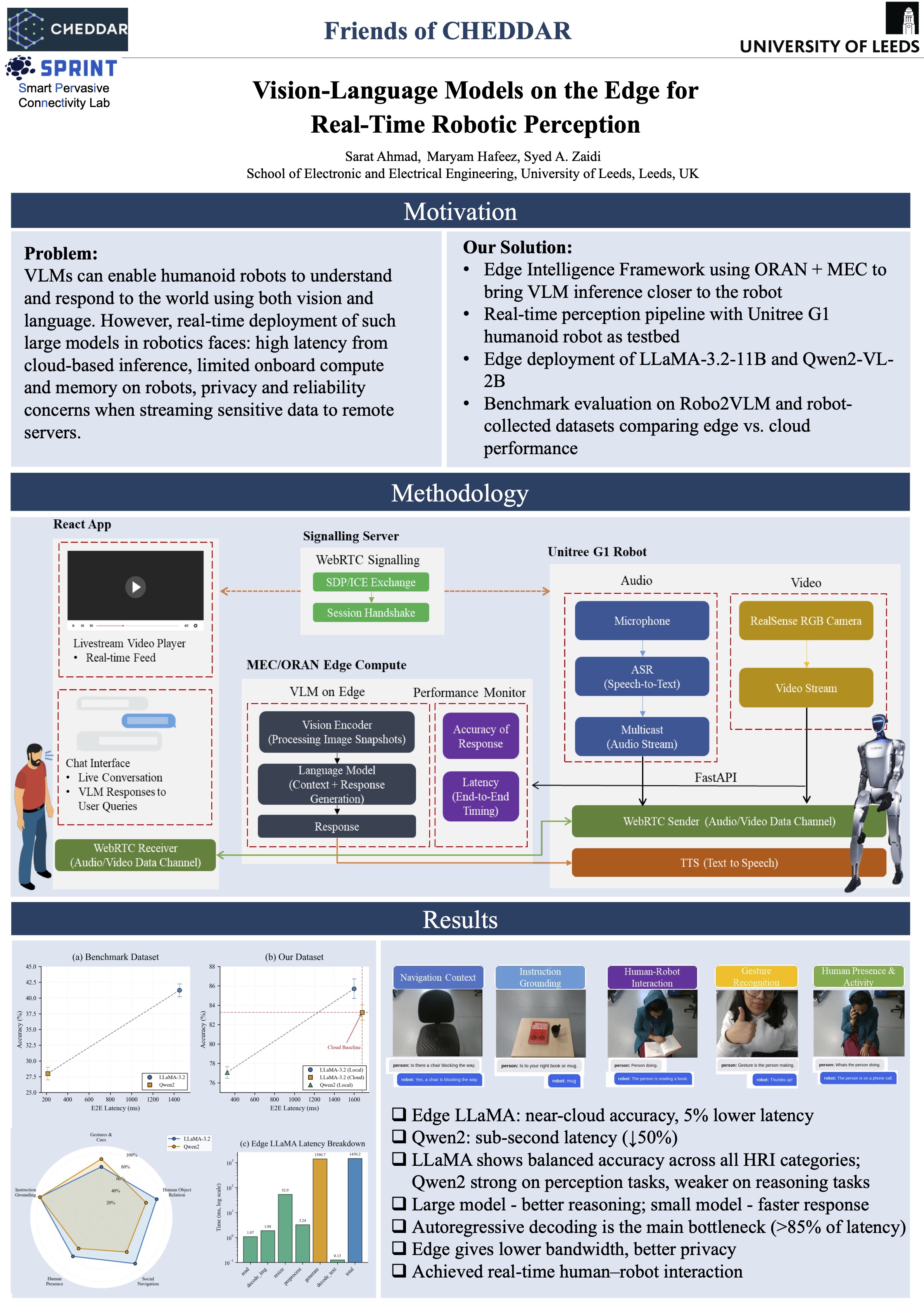
Vision-Language Models on the Edge for Real-Time Robotic Perception
Sarat Ahmad, Maryam Hafeez and Syed A. Zaidi
This research brings vision-language processing closer to humanoid robots using Open RAN and edge computing. Tests showed near-cloud accuracy with 5% lower latency, while a smaller model delivered sub-second responses and reduced latency by around 50%.
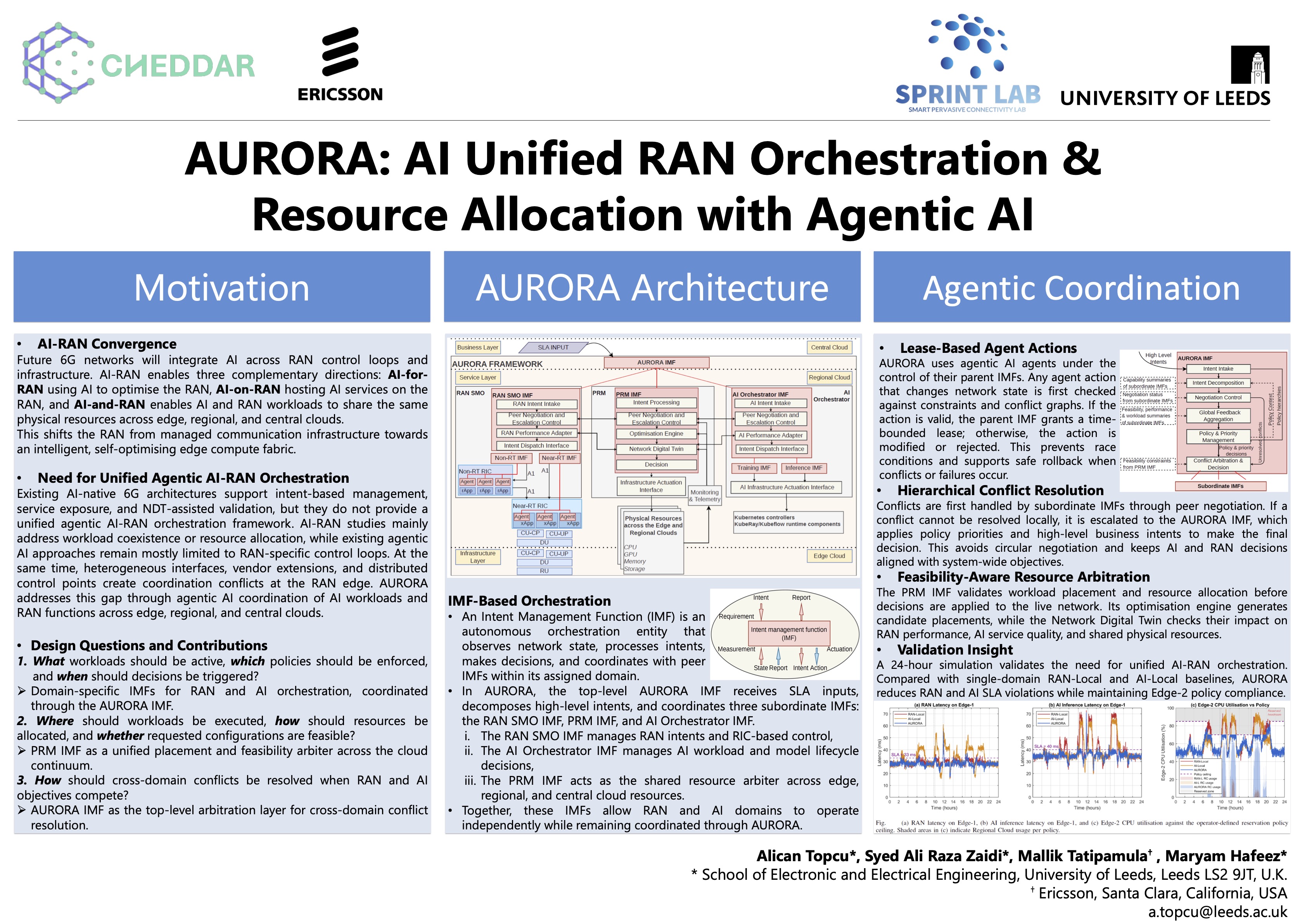
AURORA: AI Unified RAN Orchestration and Resource Allocation with Agentic AI
Alican Topcu, Syed Ali Raza Zaidi, Mallik Tatipamula and Maryam Hafeez
This poster presents AURORA, an agentic AI framework that jointly manages AI and RAN workloads across shared cloud infrastructure. By coordinating resources, resolving conflicts and checking feasibility, it could support reliable and policy-compliant AI-RAN operation in future 6G networks.
Applications of Reconfigurable Intelligent Surfaces
Mirza Shujaat Ali, Jalil Kazim, Muhammad Imran and Qammer H. Abbasi
This research shows how RIS can improve wireless coverage while supporting sensing, localisation and environmental control. Applications include vital-sign monitoring, activity recognition, non-line-of-sight localisation and more efficient future 6G networks.
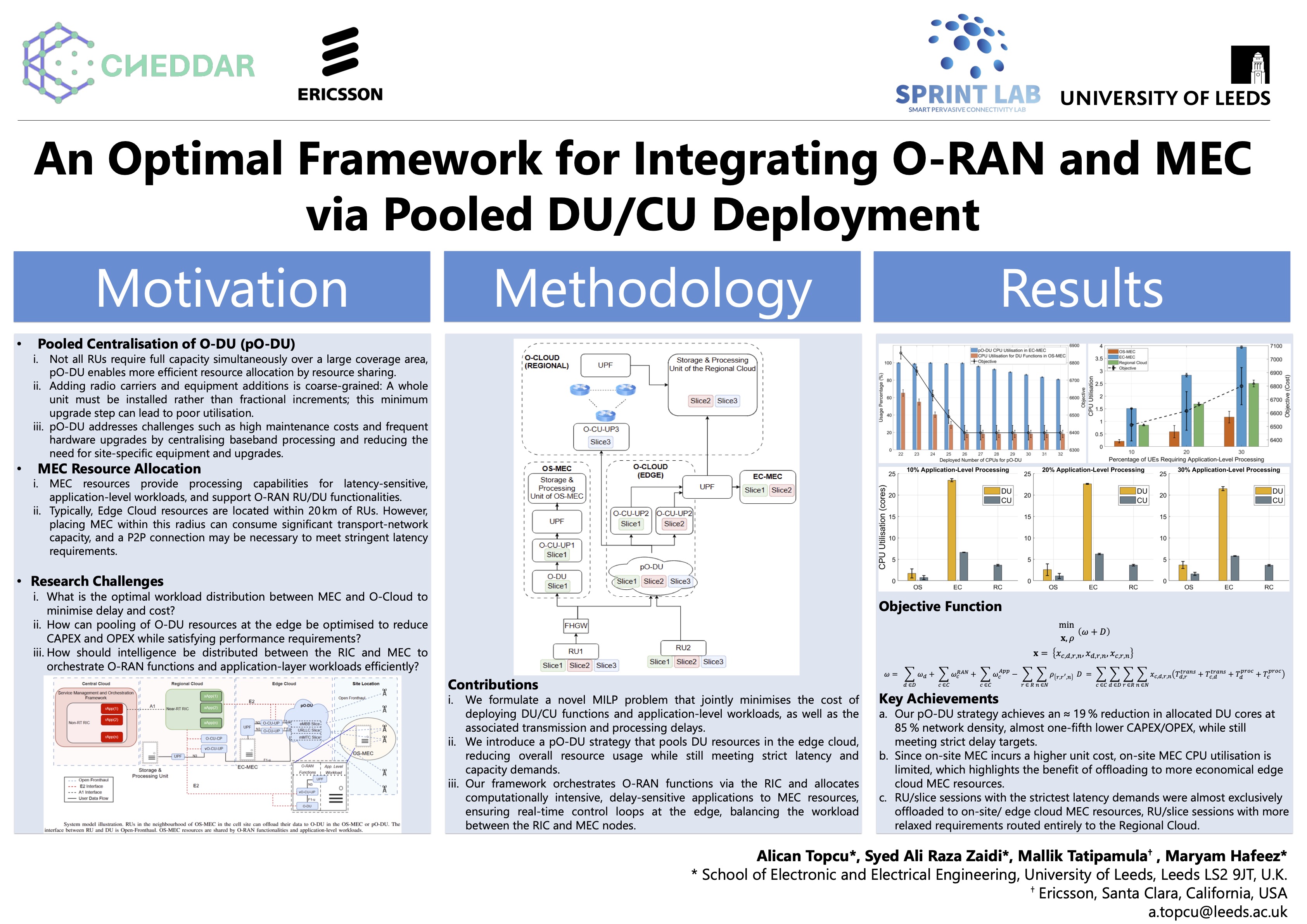
An Optimal Framework for Integrating O-RAN and MEC via Pooled DU/CU Deployment
Alican Topcu, Syed Ali Raza Zaidi, Mallik Tatipamula and Maryam Hafeez
This research presents a cost-aware framework for integrating O-RAN with edge computing. By pooling network resources and optimising workload placement, it could reduce unnecessary provisioning while maintaining latency and capacity requirements.
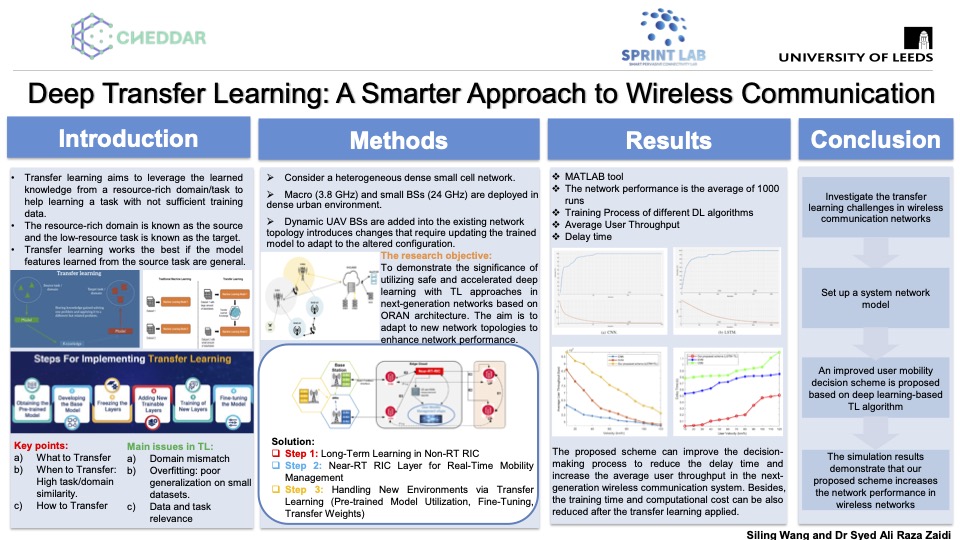
Deep Transfer Learning: A Smarter Approach to Wireless Communication
Siling Wang and Dr Syed Ali Raza Zaidi
This research uses transfer learning to help wireless networks adapt to changing environments without fully retraining AI models. Simulations showed reduced training time and computational cost, alongside higher throughput and lower delay. The approach could support faster, more efficient AI-driven network management as conditions change.
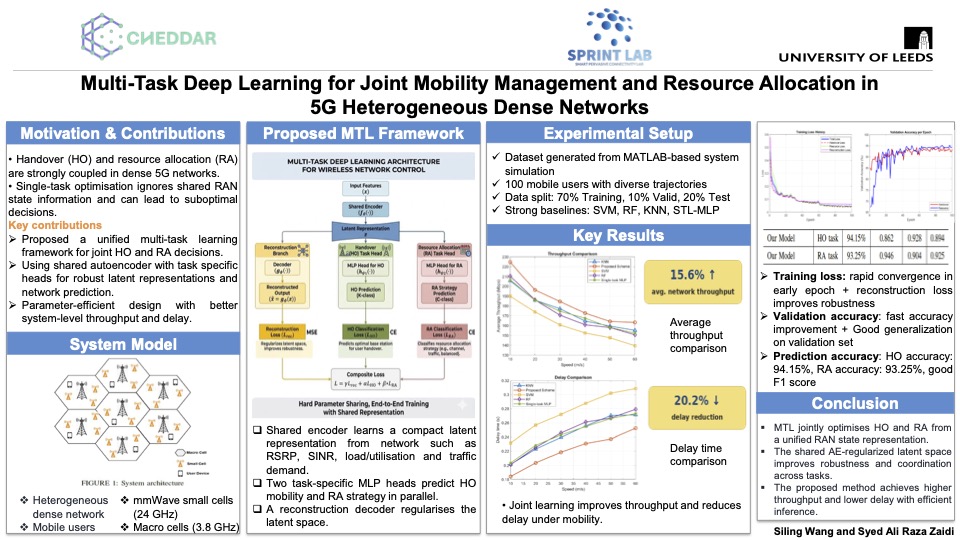
Multi-Task Deep Learning for Joint Mobility Management and Resource Allocation in 5G Heterogeneous Dense Networks
Siling Wang and Syed Ali Raza Zaidi
This research uses multi-task deep learning to coordinate handovers and radio resource allocation. Testing with 100 mobile users achieved 94.15% handover accuracy and 93.25% resource-allocation accuracy, while improving throughput and reducing delay.
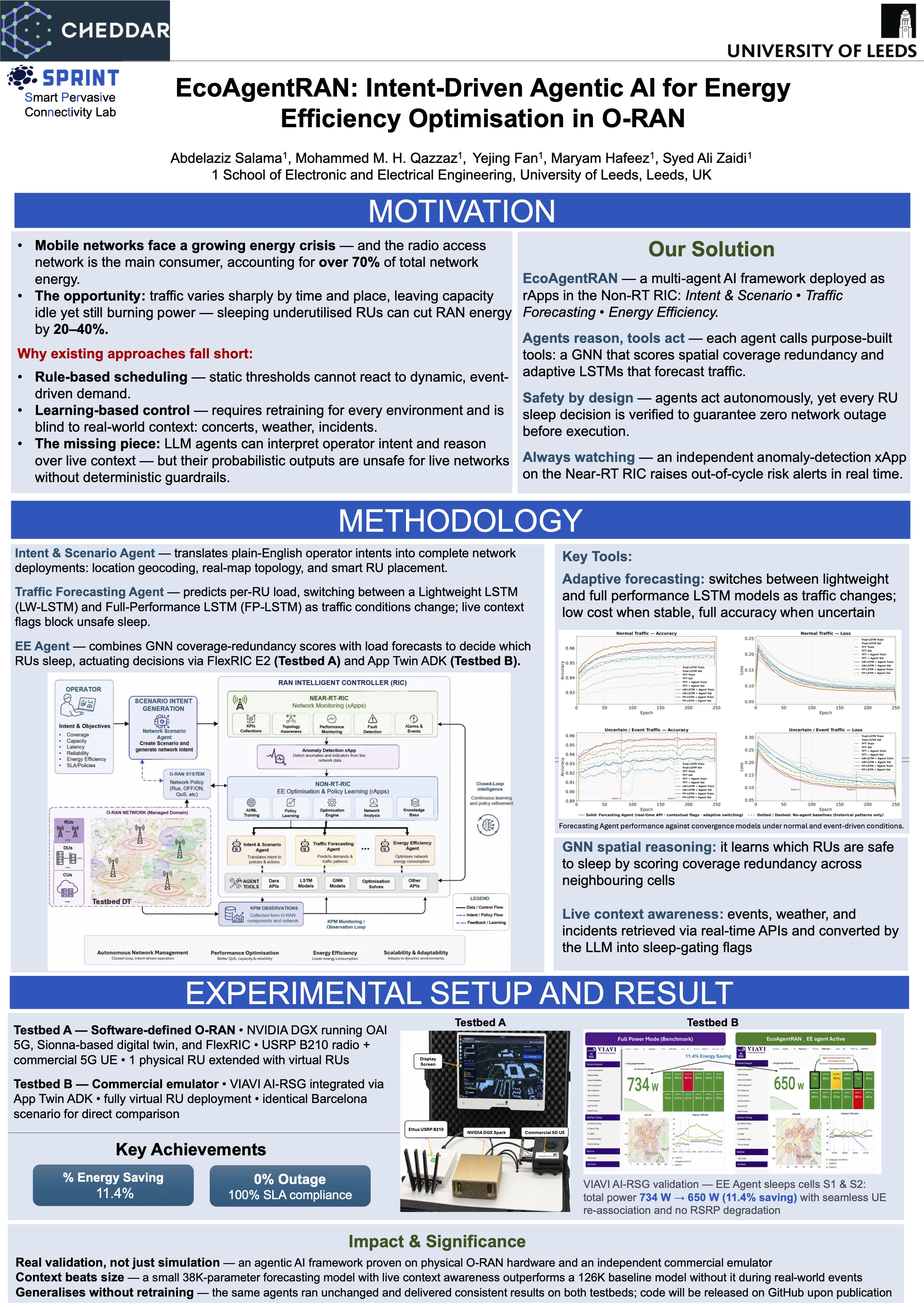
EcoAgentRAN: Intent-Driven Agentic AI for Energy Efficiency Optimisation in O-RAN
Abdelaziz Salama, Mohammed M. H. Qazzaz, Yejing Fan, Maryam Hafeez and Syed Ali Zaidi
EcoAgentRAN uses multi-agent AI to reduce energy use in Open RAN while protecting network performance. Tests achieved 11–14.5% daytime energy savings and up to 40% off-peak, with zero outages and full SLA compliance.
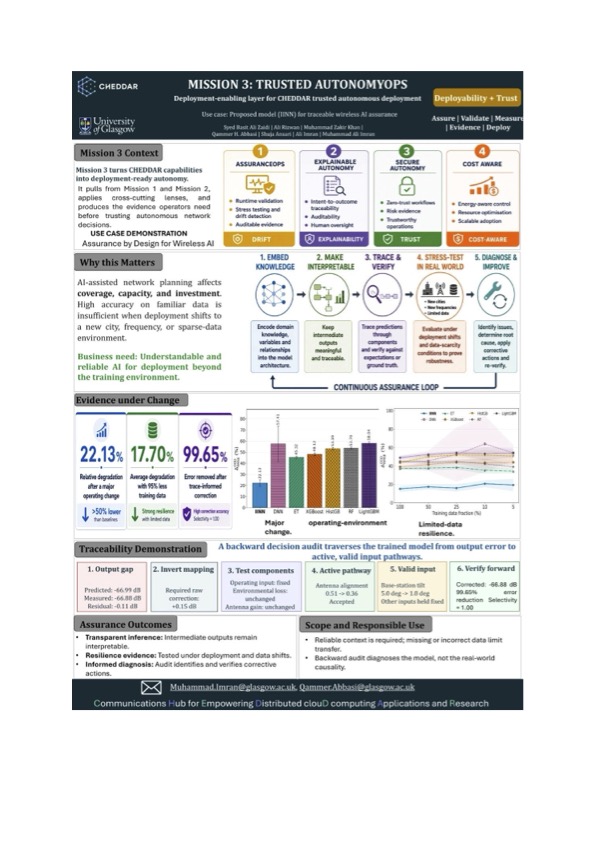
Mission 3: Trusted AutonomyOps
Syed Basit Ali Zaidi, Ali Rizwan, Muhammad Zakir Khan, Qammer H. Abbasi, Shuja Ansari, Ali Imran and Muhammad Ali Imran
Trusted AutonomyOps uses an interpretable AI model to support safe, explainable deployment in future wireless networks. It achieved around 51% lower out-of-distribution degradation and reduced prediction error by 99.65% in the example shown.
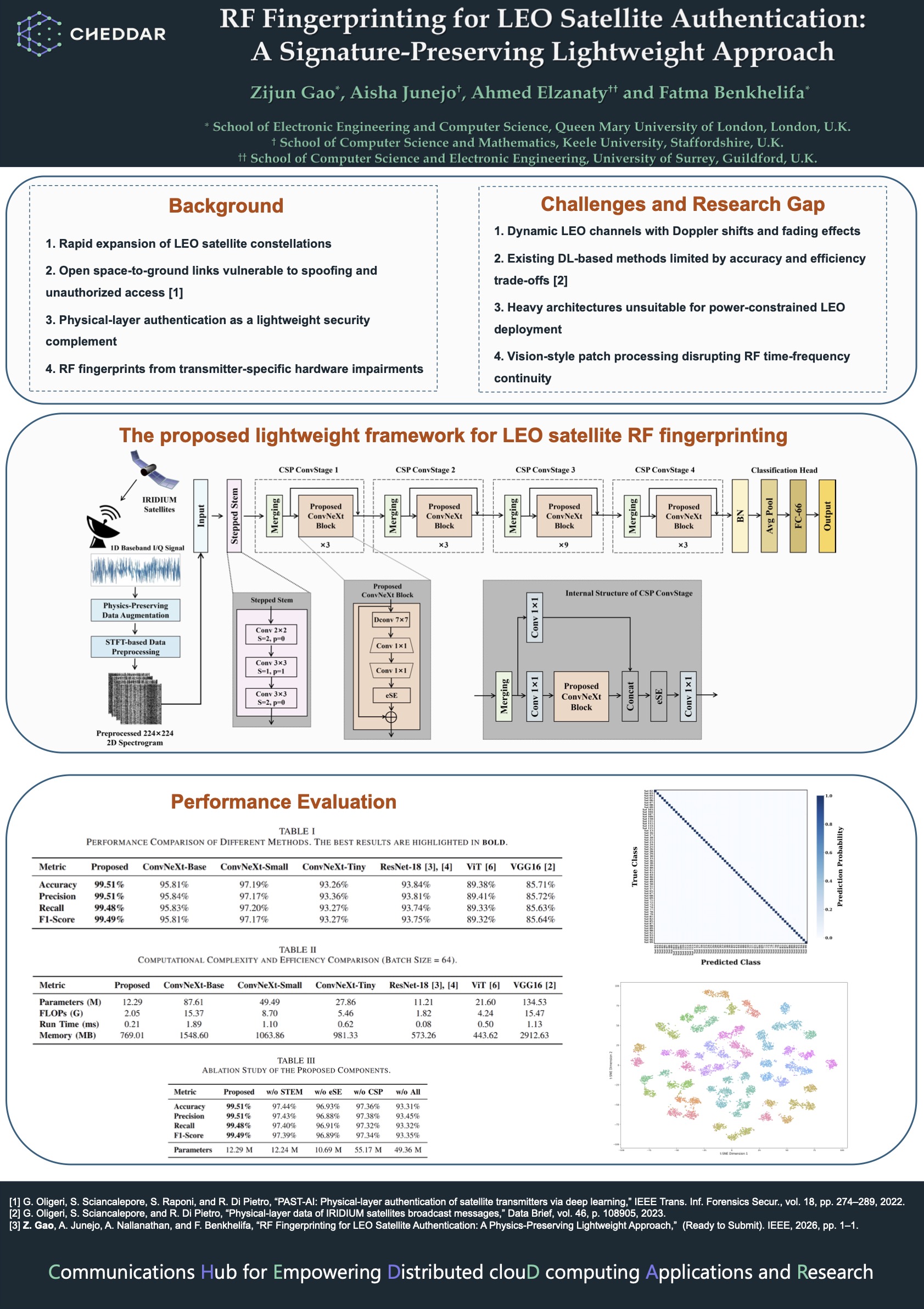
RF Fingerprinting for LEO Satellite Authentication: A Physics-Preserving Lightweight Approach
Zijun Gao and Fatma Benkhelifa, Aisha Junejo, Ahmed Elzanaty
This research proposes a lightweight RF fingerprinting method for securing LEO satellite networks. Tested on real-world IRIDIUM data, it achieved 99.51% accuracy with low computational requirements, making it suitable for resource-constrained ground receivers.
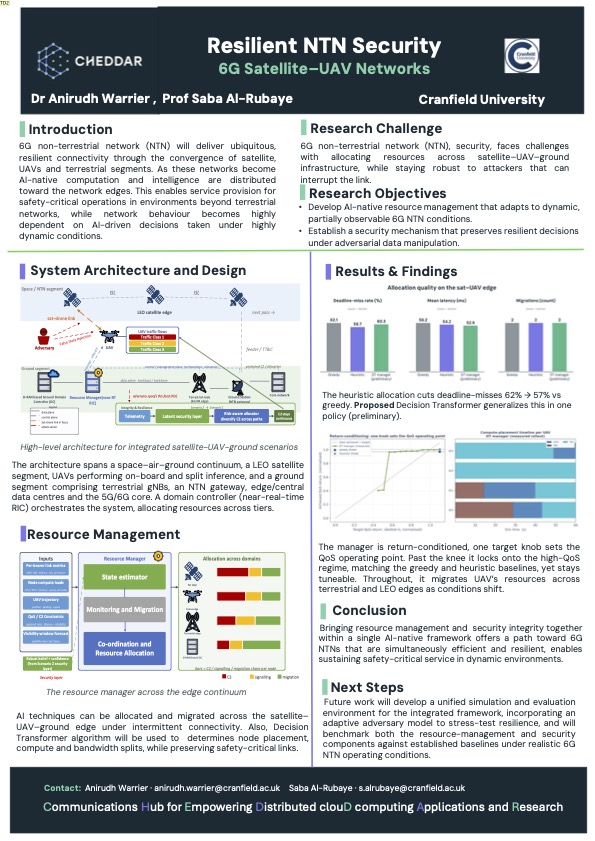
Resilient NTN Security: 6G Satellite–UAV Networks
Dr Anirudh Warrier and Professor Saba Al-Rubaye
This research develops an AI-enabled framework to improve the efficiency and security of 6G networks spanning satellites, UAVs and terrestrial infrastructure. It reduced deadline misses from around 62% to 57% compared with a greedy baseline.
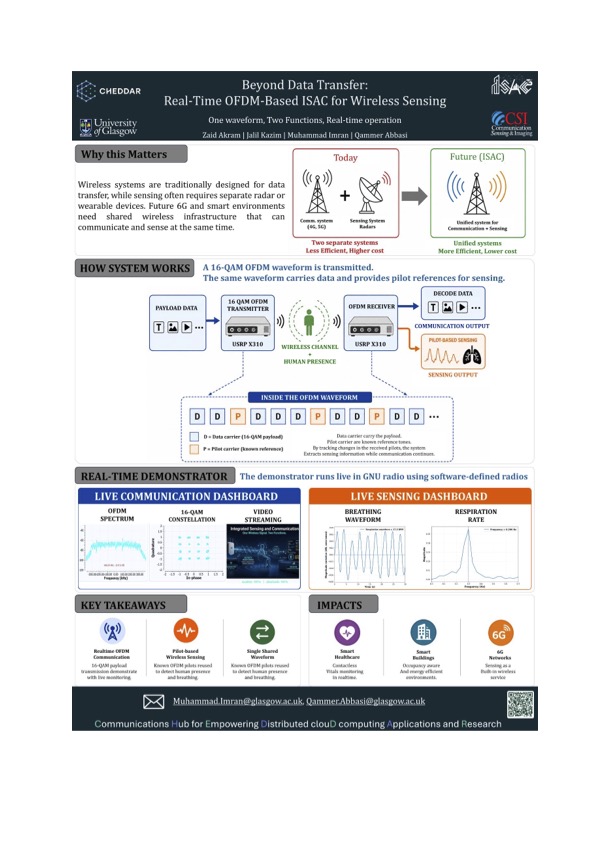
Beyond Data Transfer: Real-Time OFDM-Based ISAC for Wireless Sensing
Zaid Akram, Jalil Kazim, Muhammad Ali Imran, Qammer Abbasi
This research uses a single wireless signal for both video transmission and human sensing, including presence and breathing monitoring. The approach could reduce hardware, cost and complexity in contactless healthcare, smart buildings and future 6G networks.
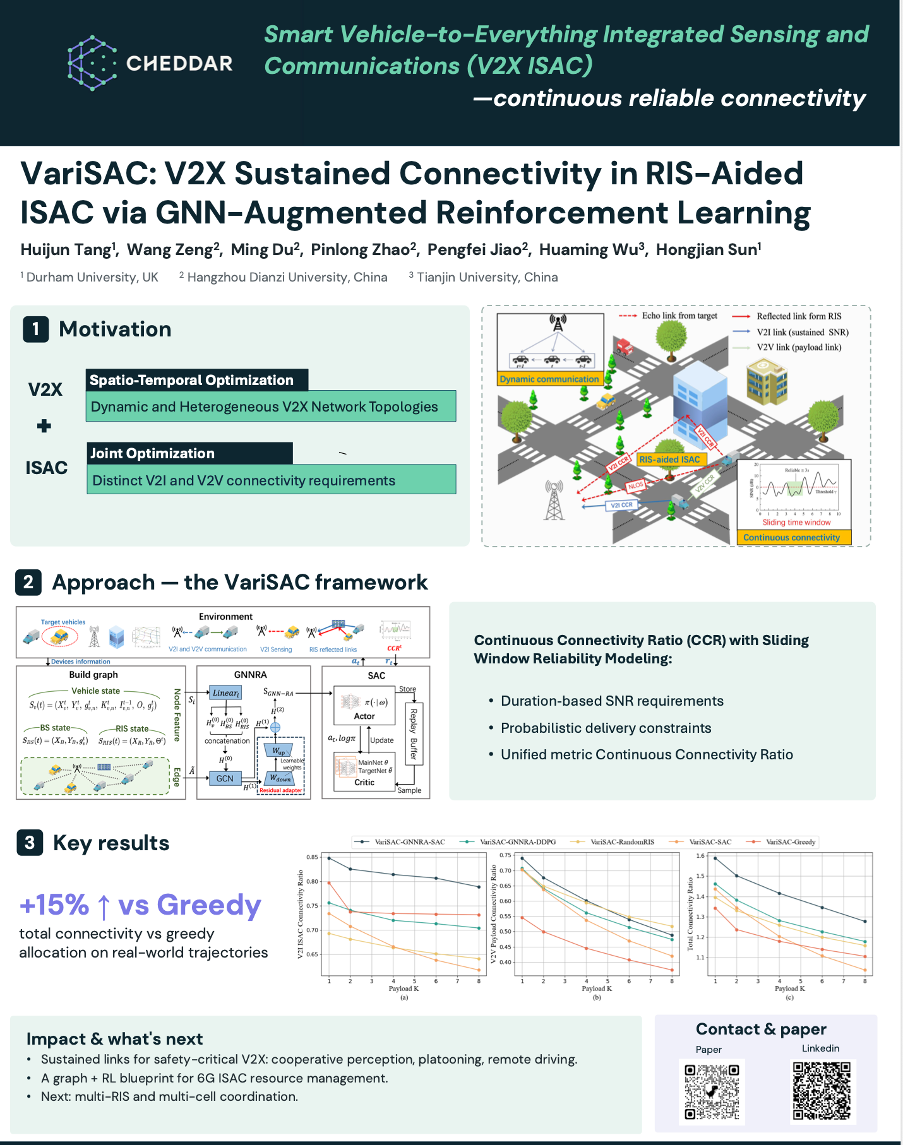
VariSAC: V2X Sustained Connectivity in RIS-Aided ISAC via GNN-Augmented Reinforcement Learning
Huijun Tang, Wang Zeng, Ming Du, Pinlong Zhao, Pengfei Jiao, Huaming Wu and Hongjian Sun
VariSAC uses AI and reconfigurable intelligent surfaces to maintain reliable vehicle connectivity as road and network conditions change. Tests using real-world trajectories improved total connectivity by 15% compared with a greedy approach.