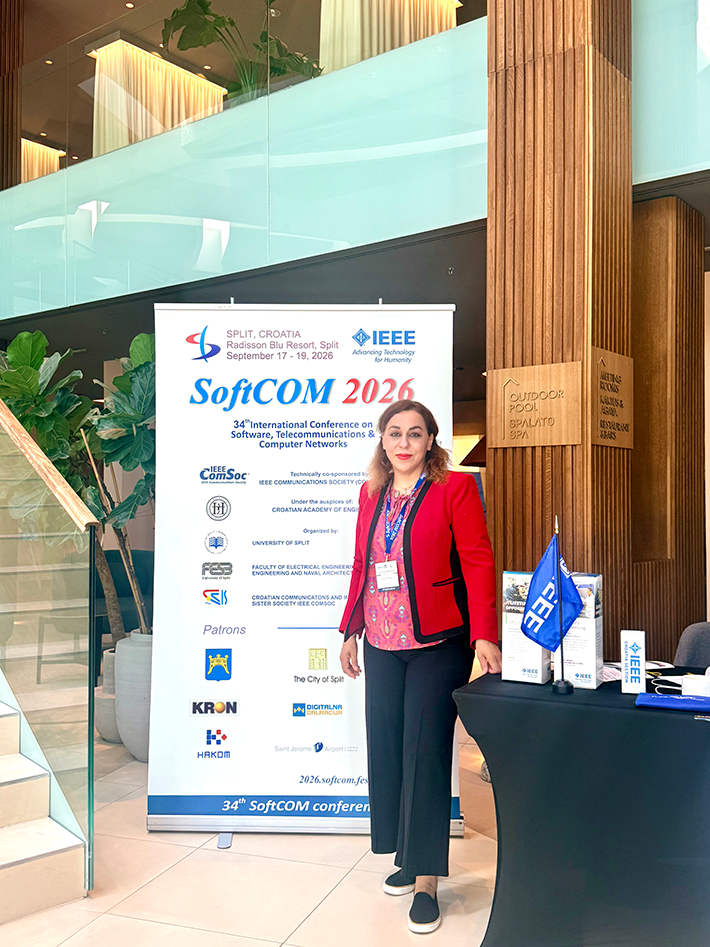
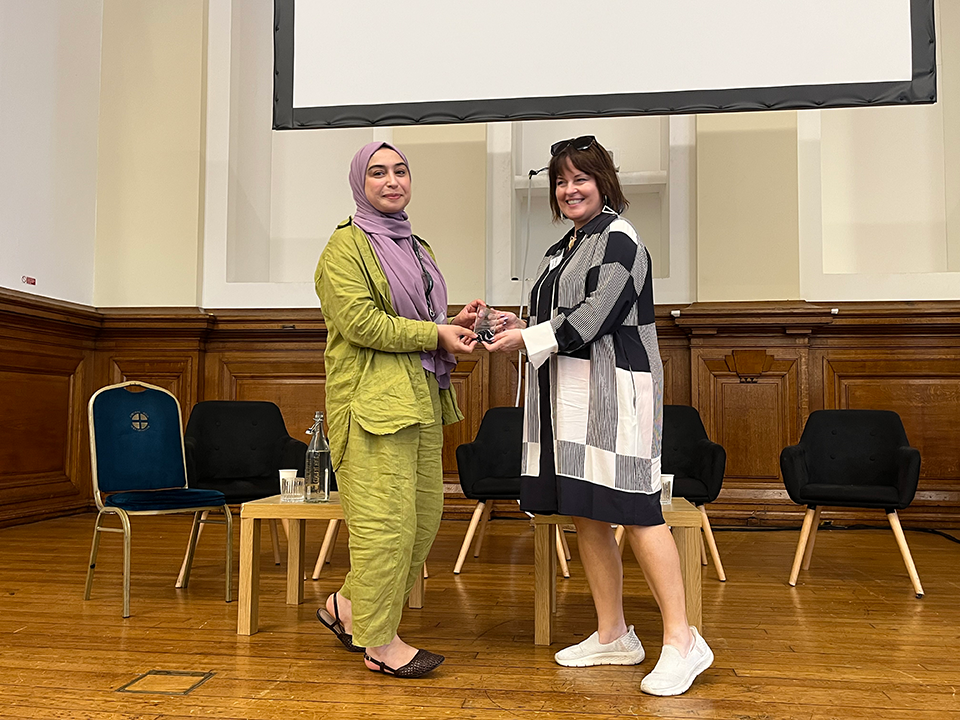
For the latest Women in Connectivity feature, we speak to Imperial College London researcher Yathreb Bouazizi about the journey that took her from reading science magazines as a child to researching the future of wireless networks.
Yathreb’s work explores how networks can do more than connect devices, including sensing their surroundings and supporting smarter, more sustainable infrastructure. She shares what she learned from working in industry and carrying out research across London and Singapore, why real-world deployment matters to her, and her advice for women considering a career in engineering.
Can you tell us a little about your journey into engineering and connectivity, and what first sparked your interest in the field?
I think my journey into engineering began long before I chose a degree or a career. When I was a child, my father used to buy us Science et Vie, a popular French science magazine that covers a wide range of topics, including space, satellite navigation, physics, optics, and emerging technologies, all explained in clear, accessible language. I spent my weekends reading these articles. I am not sure whether it was my father’s quiet way of nudging us towards science and engineering. What I am certain of, though, is that those magazines were what fuelled my curiosity.
As I grew older, that curiosity naturally led me towards engineering. I was drawn to telecommunications because it sits at a rare intersection of different worlds that I found fascinating. On one side, it is deeply mathematical, involving probability, signal processing, information theory, and coding theory. At the same time, it is strongly rooted in physics, particularly electromagnetics, wave propagation, and optics. That combination and how it is turned into ways that connect people, machines, and the physical world really appealed to me.
Your research spans areas including low-power wide-area networks, joint communication and sensing and reconfigurable intelligent surfaces. What excites you most about the work you are doing now?
What excites me most about my research is the opportunity to bridge two worlds that are often treated separately: analytical modelling and real-world deployment. Whether it is a LoRa network, an NB-IoT network, an ISAC-perceptive network, or an RIS-enabled network, the question is: can we build models realistic enough to predict what will happen when we deploy these networks at scale?
For me, the model is not just a mathematical exercise. It is the starting point for understanding a network: how it will behave, where its limitations sit, and how different design choices will affect its performance. The technologies may change, but the underlying goal remains the same: to understand complex wireless systems well enough to design them more intelligently and efficiently, with confidence that what works on paper will also work in the real world.
You completed your PhD at Imperial College London and are now continuing your research as a Postdoctoral Research Associate. How has your research evolved since you first began your PhD?
I believe my PhD gave me a practical approach to research, along with rich multicultural and interdisciplinary experience, both of which have strongly shaped the independent researcher I am today. My PhD was part of a multidisciplinary project bringing together academia (Imperial College London), research institutes through the Agency for Science, Technology and Research (A*STAR) in Singapore, and government stakeholders through the Housing and Development Board of Singapore. The goal was to help HDB optimise its urban infrastructure and make it smarter and more sustainable, with applications as diverse as smart parking, smart buildings, lift monitoring, predictive pipeline maintenance, and control of water-harvesting systems.
My role was to examine the connectivity challenges behind these applications: what kind of network can reliably support these different demands? We proposed LoRa-based connectivity and studied it at several levels, from the behaviour of an individual link to network-level performance, and ultimately to field deployment, with one of the first outdoor LoRa networks in Singapore deployed in an HDB estate at the time.
As I moved into my postdoctoral research, I carried with me that practical, application-oriented, requirements-driven thinking and realistic deployment constraints, but my research began to evolve towards broader 6G-oriented questions with a particular interest in how wireless infrastructures can be repurposed to serve multiple functions, going beyond ensuring connectivity between a sensor and a gateway to transmit data for a specific application.
What do you think are some of the most exciting opportunities emerging from future connectivity technologies such as 6G, intelligent wireless environments and integrated sensing and communications?
I think one of the most exciting opportunities emerging from future connectivity technologies lies in rethinking the role of the wireless medium. We are seeing how the wireless medium that has been perceived for decades as random and uncontrollable is turned into a tuneable asset through technologies like metasurfaces, reconfigurable intelligent surfaces, flexible antenna etc… Beyond tunability, the wireless medium’s role is now shifting from being a carrier to becoming an infrastructure that can be leveraged to provide services beyond connectivity, including sensing, environmental awareness, wireless power transfer, and over-the-air computation and inference. Even what used to be the main weakness of the wireless medium, interference, is now turned into a feature that can be reaped to fulfil these services. This represents more than a technical evolution; it is reshaping the role of network infrastructure, enabling providers to deliver not only connectivity but an array of add-on services.
While this flexible, multi-functional vision brings opportunities and extends capabilities, it also introduces challenges and expands the attack surface. Network design should therefore consider not only efficiency, scalability, and latency but also privacy and security, built in from the outset rather than retrofitted.
Much of your work explores technologies that could make future networks more intelligent, adaptive and efficient. What real-world impact would you most like to see your research have?
I hope my research contributes to the design of scalable, reliable, multifunctional networks that can operate effectively under realistic deployment constraints, particularly in challenging environments such as smart cities and industrial and manufacturing settings, thereby supporting their digital transformation in an efficient yet sustainable way. Ultimately, I aim to close the loop from modelling to prediction, optimisation, and eventually real-world deployment, so the models and methods we develop translate into practical, deployable solutions and design guidelines.
Research careers rarely follow a completely straightforward path. What has been one of the biggest challenges in your career so far, and what did you learn from it?
One of the biggest challenges in my career was probably finding my way back into research after spending a few years working in industry as a telecommunications engineer following my MSc. At the time, returning to academia meant stepping into an environment very different from what I was used to. I had to reconnect with academic research, develop new expertise, and adapt to a more exploratory way of approaching problems. But looking back, I see that decision as one of the most important turning points in my career. My industry experience gave me a practical understanding of engineering and real-world constraints, and returning to research allowed me to combine that experience with a deeper interest in developing new knowledge.
My PhD itself was also far from a conventional PhD journey. I spent it between London and Singapore, where I worked as a research assistant at A*STAR, collaborating with people from different disciplines and cultural backgrounds and working closely with several stakeholders. What made that experience particularly challenging yet rewarding was balancing several responsibilities at once. I needed to understand the requirements of real-world infrastructure projects, communicate effectively with industrial and government partners, and, at the same time, maintain independence in my research and develop my own scientific contribution.
The biggest lesson I took from these experiences is that a research career does not need to follow a straight line or a specific path to be meaningful. My time in industry, the international nature of my PhD, and my exposure to real-world challenges have all shaped how I approach research today.
Have there been any mentors, colleagues or role models who have had a particularly important influence on your career?
I feel very fortunate to have been surrounded by successful, inspiring women throughout my academic journey. First, my supervisor and mentor, Prof. Julie McCann, has been incredibly generous in sharing her knowledge and expertise, supporting me as a student and believing in my abilities as a postdoc. Second, Dr Fatma Benkhelifa, who was an important source of encouragement and helped me recognise my strengths during my PhD. I am very grateful to both of them.
You are also involved in Equity, Diversity and Culture within the Department of Computing. Why is representation important in engineering, telecommunications and connectivity research?
Imperial places a strong value on equity, diversity, and inclusion, and being involved in the Department of Computing’s Equity, Diversity, and Culture activities gives me an opportunity to contribute to that commitment. I see my role as representing the experiences and perspectives of women postdocs, helping ensure that their voices are heard and that their contributions are recognised. Representation also matters to me beyond improving diversity within academia today. Through outreach activities, mentoring, and events that encourage young people to explore engineering and computing, I hope to make “inspiring the next generation of women in engineering” practical and meaningful.
What would you say to women and girls who are considering a career in telecommunications, computing or engineering but may not yet see themselves represented in these fields?
I would say don’t feel discouraged by the lack of representation. Engineering, computing and telecommunications need people with different perspectives, experiences and ways of thinking, and there is a place for you in these fields. There is no perfect moment when you feel completely ready to seize opportunities, so don’t wait for it; be willing to take the initiative, step outside your comfort zone, and learn along the way. And most of all, be proud of what makes you unique
Looking ahead, what would you most like to achieve over the next few years, either through your research or through your wider contribution to the connectivity community?
On the research side, I would like to further develop my work on multifunctional networks to address real-world application needs and bridge the gap between analytical modelling and deployment. More broadly, through my involvement in equity and culture work, I would like to help create an environment where people from diverse backgrounds feel they belong and help inspire the next generation of women in engineering.