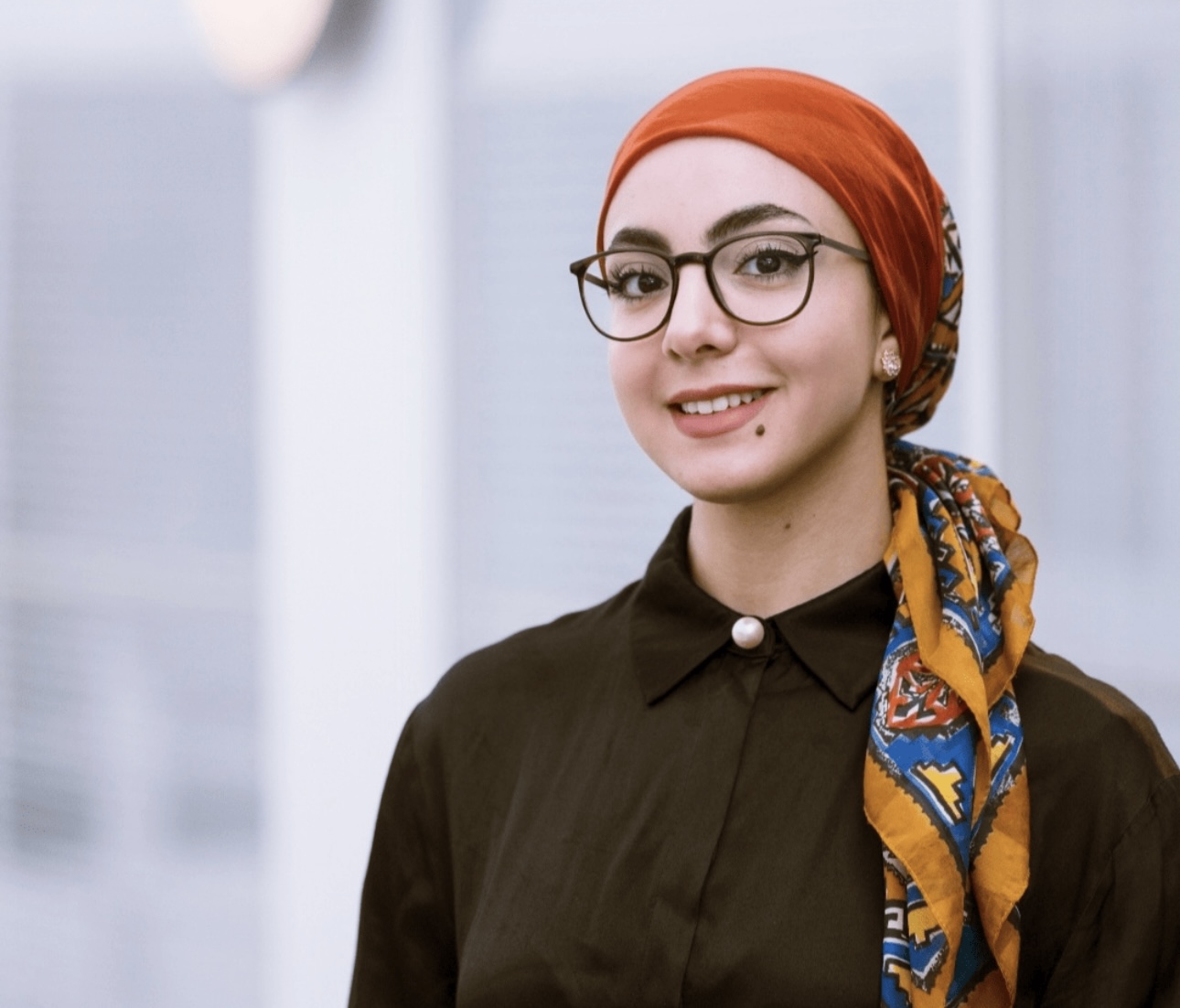
In this edition of Voices from the Lab, we speak to Mariem Chemingui, a postgraduate student at the 5G/6G Innovation Centre, University of Surrey, and a part-time Research Assistant on the 6G-AI-FINESSE project within the CHEDDAR Hub at Keele University.
Mariem has recently been awarded the Mitacs Globalink Research Award, supporting her international research collaboration and recognising the growing impact of her work in next-generation wireless communications.
Her research explores the future of 5G/6G systems, with a particular focus on intelligent, sustainable and EMF-aware wireless technologies. In this interview, Mariem shares what first drew her to wireless communications, how her background has shaped her research journey, and why the move towards 6G opens up exciting new possibilities for connectivity, sensing and real-world impact.
What first drew you to wireless communications, and what keeps you excited about the field today as we move towards 6G?
Growing up in Tunisia, connectivity was never an abstract concept. You could see who had reliable access to information and opportunities, and who did not. That stayed with me long before I formally studied communications engineering.
When I joined École Polytechnique de Tunisie, after ranking in the top two per cent of the national entrance examination, I was immediately drawn to the mathematics and physics behind wireless systems. But what kept me in the field was the realisation that communication networks shape how people access education, healthcare, and opportunity.
What excites me most about 6G is that the conversation is expanding beyond speed and capacity. We are now asking broader questions: how sustainable these networks are, how they interact with the electromagnetic environment around us, and how communication systems can become more intelligent and adaptive.
My research at the University of Surrey focuses on these challenges, particularly the joint design of communication, sensing, and electromagnetic field (EMF)-aware systems, which address how wireless signals interact with and are absorbed by the human body. I find this exciting because it pushes us to rethink what “good network design” really means.
As an early-career researcher, I have also learned the importance of perspective. Coming from North Africa and working in an international research environment has taught me that the questions you ask in research are shaped by what you have seen and lived. That is not a limitation. It is exactly what the field needs more of.
Your research explores EMF-efficient MU-MIMO systems. How important is it that future networks are not just faster, but also environmentally and biologically responsible?
I believe it is essential. Future networks cannot be considered successful if performance improvements come at the expense of sustainability or public trust. What is interesting is that these goals are not necessarily in conflict. In many cases, smarter system design allows us to improve both performance and exposure efficiency at the same time.
In my research on EMF-aware MU-MIMO systems, published in IEEE Transactions on Green Communications and Networking, I showed that treating EMF exposure as a design objective from the beginning, rather than checking it afterwards, can significantly reduce uplink exposure while maintaining network throughput.
I observed a similar result in my work on integrated sensing and communication systems, where EMF-aware waveform design achieved around forty per cent reduction in downlink EMF exposure without degrading sensing or communication performance.
For me, the key lesson is that sustainability and safety should not be afterthoughts in 6G. They need to be embedded into the architecture of the network itself.
Your work also explores aerial and satellite communications. How critical are these technologies for achieving truly ubiquitous connectivity?
Absolutely critical, and I want to approach this from an angle that is often overlooked. Most discussions around satellite and aerial communications focus on coverage maps, capacity and technical performance. My research asks a different question: what does that connection mean for the person on the other end of the link?
When a device connects directly to a satellite rather than a nearby base station, it transmits at significantly higher power. That increase directly affects electromagnetic exposure for the user, which is the problem I have spent my PhD solving in terrestrial networks. Extending connectivity into space does not make that problem disappear. It makes it more urgent.
Security matters equally. Satellite channels are broadcast by nature, and securing them is genuinely hard. Without trustworthy links, coverage alone means very little.
For me, ubiquitous connectivity means networks that reach everyone, protect the people using them, and can be trusted with sensitive data. Those are not separate goals. They are one design problem, and that is what connects everything I work on.
What is the hardest technical problem you’re currently trying to solve and why does it matter?
One of the most difficult challenges in my PhD research is the joint optimisation of communication performance, sensing accuracy, and EMF exposure in large-scale intelligent surface networks. These objectives are deeply interconnected because they depend on the same beamforming and resource allocation decisions. Improving one metric can easily affect the others, which makes scalable optimisation extremely challenging.
At the same time, during my research work at Keele University within the CHEDDAR Hub, we are investigating secure key generation for satellite systems with inherently low-entropy channels. While we have promising early results, extending these methods to realistic multi-satellite environments remains an open problem.
What connects both research challenges is the idea of trust. Future communication systems must not only deliver high performance, but also provide safety, security, and reliability in a way that society can confidently adopt.
What is one breakthrough you hope to see in 6G that would truly change society?
I would like to see 6G become an infrastructure that people can rely on as naturally as they rely on electricity or clean water: reliable, intelligent, secure and responsibly designed from the outset.
For me, the real breakthrough is not a single data rate or technology. It is the ability to build networks that people can trust in everyday life, whether in healthcare, transport, education or emergency response.
Finally, I hope more women see wireless research not as a narrow technical field, but as a space where their perspectives can directly shape how future networks are designed and used.
Many of the most important questions in 6G, about trust, safety, accessibility, and impact on society, are not purely technical questions. They benefit from different ways of thinking and different lived experiences. For me, diversity is not something added to innovation. It is part of what changes the direction of the questions we ask in the first place