Road to 6G: Hype vs Reality
1 Jun, 2026
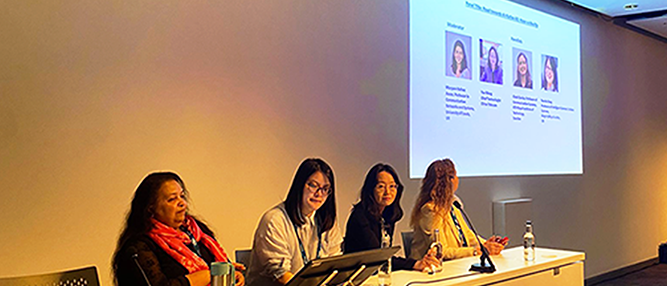
As part of the CHEDDAR Workshop: Shaping the Future of Advanced Connectivity Technologies, the second panel, “Road to 6G: Hype vs Reality,” brought together leading voices to discuss how the future of 6G can move from ambition to practical, sustainable impact. The workshop focused on key emerging drivers for 6G, including architecture, agentic AI, semantic communications, non-terrestrial networks, operator’s deployment perspective and 6G as an enabler for real-world applications.
Dr Maryam Hafeez opened the discussion by challenging the audience to separate AI’s proven value from the growing hype surrounding AI-native 6G. If future 6G networks are to become truly AI-native, are the underlying AI technologies sufficiently mature and tested to support critical communication services where reliability is paramount? AI undoubtedly offers transformative opportunities for telecoms as indicated by GSMA’s recent statistics, but the path to AI-native 6G must balance innovation with the industry’s uncompromising requirements for robustness and quality of service guarantees.
Dr Maryam Hafeez reflected on the importance of applying AI in 6G systems in a considered and purposeful way:
“The road to AI-native 6G is not about inserting AI everywhere; it is about identifying where intelligence creates measurable value and embedding it into network architecture responsibly.”
Dr Yue Wang brought a valuable industry and standards perspective to the panel. As Chief Technologist at China Telecom, her work focuses on AI-native mobile networks and network-cloud convergence for AI, spanning foundational innovation through to pilot deployments. Her contribution highlighted the importance of turning 6G vision into practical deployment pathways. She said that while AI offers unprecedented gains on paper, operator’s perspective is that it will take some time for it to mature into telco-grade standards.
Professor Cicek Cavdar brought a strong perspective on sustainable and resilient network design. With research interests spanning telecommunication networks, non-terrestrial networks, energy efficiency and 5G network architectures, her contribution connected the 6G debate to the practical choices that will shape future systems. She argued that AI must only be used where it can deliver meaningful value without creating sustainability challenges, such as growing space debris due to overcrowding of low Earth orbit. She said 6G will need an architectural shift to enable true integration of AI to go beyond just using it as an optimisation layer on top of existing telecom architecture.
Professor Yansha Deng added important insight into how 6G can support smarter systems and real-world applications. Her contribution reflected the need to think beyond speed alone, focusing instead on how future networks can be designed to deliver reliability, intelligence and meaningful value for society. She highlighted the importance of edge computing and how the distribution of AI workloads across edge-cloud continuum is central to harnessing true gains from AI.
Professor Yansha Deng reflected on the shift from 6G vision-setting towards practical AI-native network design:
“AI-native networking is becoming a reality rather than hype, driven by the rapid advancement of AI algorithms and applications. The 6G network must be designed to support emerging AI applications, with AI optimisation integrated seamlessly across different layers of the future network.”
Dr Neeli Prasad added important insight into how 6G can support smarter systems and real-world applications. Her contribution reflected the need to think beyond speed alone, focusing instead on how future networks can be designed to deliver reliability, intelligence and meaningful value for society. She challenged the community to separate a genuine 6G opportunity from an overstatement. Her contribution reinforced the importance of being clear about what 6G can realistically deliver more than what already exists, and where expectations need to be managed, particularly in areas that are often heavily promoted.
Together, the speakers reinforced a clear message: 6G is real, but its future must be grounded in reality. The road to 6G is not simply about faster connectivity. It is about making deliberate choices around compute distribution, network architecture, sustainability and deployment, so that future networks are smarter, more resilient and more sustainable.