Protecting privacy when wireless networks can also sense movement
23 Nov, 2026
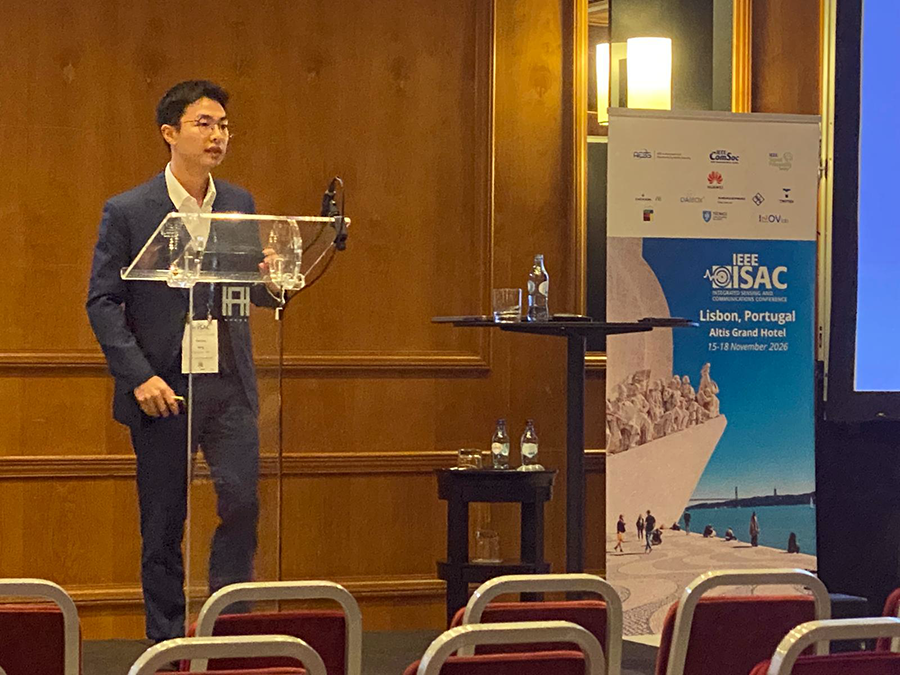
At IEEE ISAC 2026 in Lisbon, Dr Yinchao Yang from Imperial College London presented CHEDDAR-supported research into how future wireless networks could protect both private messages and information about activity in a room.
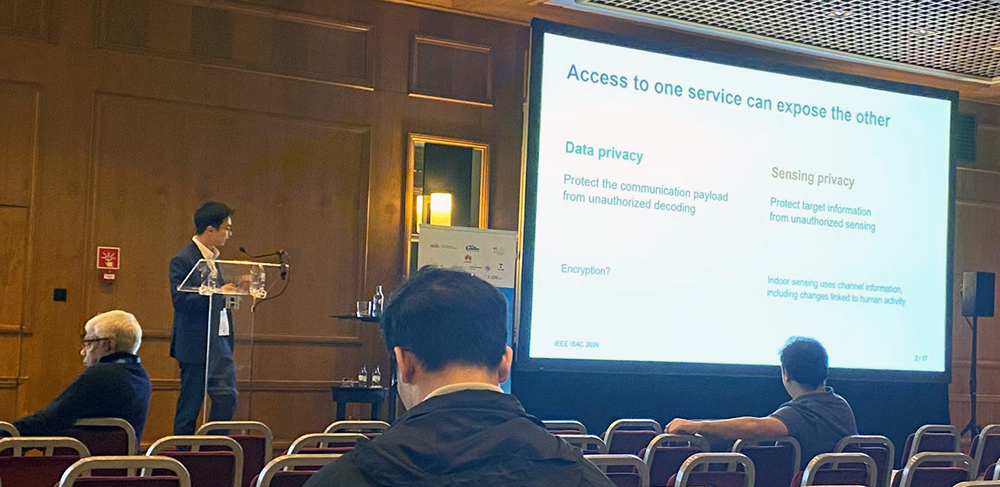
Wireless signals carrying data can be used to detect movement by reflecting off people and objects. These combined functions are known as integrated sensing and communications (ISAC), could give future networks new capabilities. It also raises a privacy question. If two services use the same signal, could someone authorised to use one learn information from the other?
In his presentation, Yang explored how this could happen in an indoor network. A communications user might use signal reflections to infer movement in a room, while a sensing user might try to decode messages intended for someone else. In the study, both users had legitimate access to the network. The challenge was to protect the information each service was meant to keep private.
Using artificial noise to protect both services
The team explored a technique called temporal artificial noise. It uses a feature of the wireless waveform called the cyclic prefix, a short section at the start of each transmitted block that a communications receiver normally removes before decoding the data.
The researchers designed the noise so that, under the study’s channel assumptions, its effect cancels out during normal decoding by the authorised communications receiver. Its effect generally remains when the sensing receiver attempts to decode the same messages, making them harder to recover.
For authorised sensing, the receiver has a reference copy of the full transmitted waveform, including the artificial noise. It can compare that reference with the returning echo to estimate the target’s response. A communications user attempting to sense the same target has a reference based on the decoded data alone. The resulting mismatch makes it harder to interpret the echo accurately.
What the simulations showed
The researchers examined how to divide transmit power between the data signal and the artificial noise. At the study’s standard transmit power, authorised sensing accuracy remained broadly stable across the security settings tested. Stronger privacy requirements reduced signal quality for authorised communications users. When the team lowered the total transmit power, sensing accuracy also declined.
That trade-off matters for future network design. The results show how the same technique can help protect messages and sensing information, while giving researchers a way to assess the cost of stricter privacy requirements for each service.
The study used a simplified indoor model with one communications user, one sensing user and one target. It also assumed the transmitter had perfect knowledge of the wireless channels. Yang outlined next steps that include testing the approach when that knowledge is imperfect and in indoor environments with more complex signal reflections.
Yang presented the paper “Dual-Security for Indoor OFDM-ISAC Systems via Temporal Artificial Noise” at IEEE ISAC 2026, which took place from 16 to 18 November in Lisbon, Portugal. He co-authored the paper with Yathreb Bouazizi, Prabhat Raj Gautam, Michael Breza and Julie A. McCann. The research was supported by EPSRC through the CHEDDAR Hub, IntentMAPs and the National Edge AI Hub.