CHEDDAR researchers present advances in integrated sensing and communications at IEEE ISAC 2026
17 Nov, 2026
CHEDDAR researchers are presenting new approaches to health monitoring, intelligent wireless environments and secure communications at the inaugural IEEE Conference on Integrated Sensing and Communications (ISAC 2026), held 16–18 November in Lisbon, Portugal.
The conference brings together researchers from around the world and industry experts to explore how sensing and communications can work together in future wireless networks a key area of research in developing 6G.
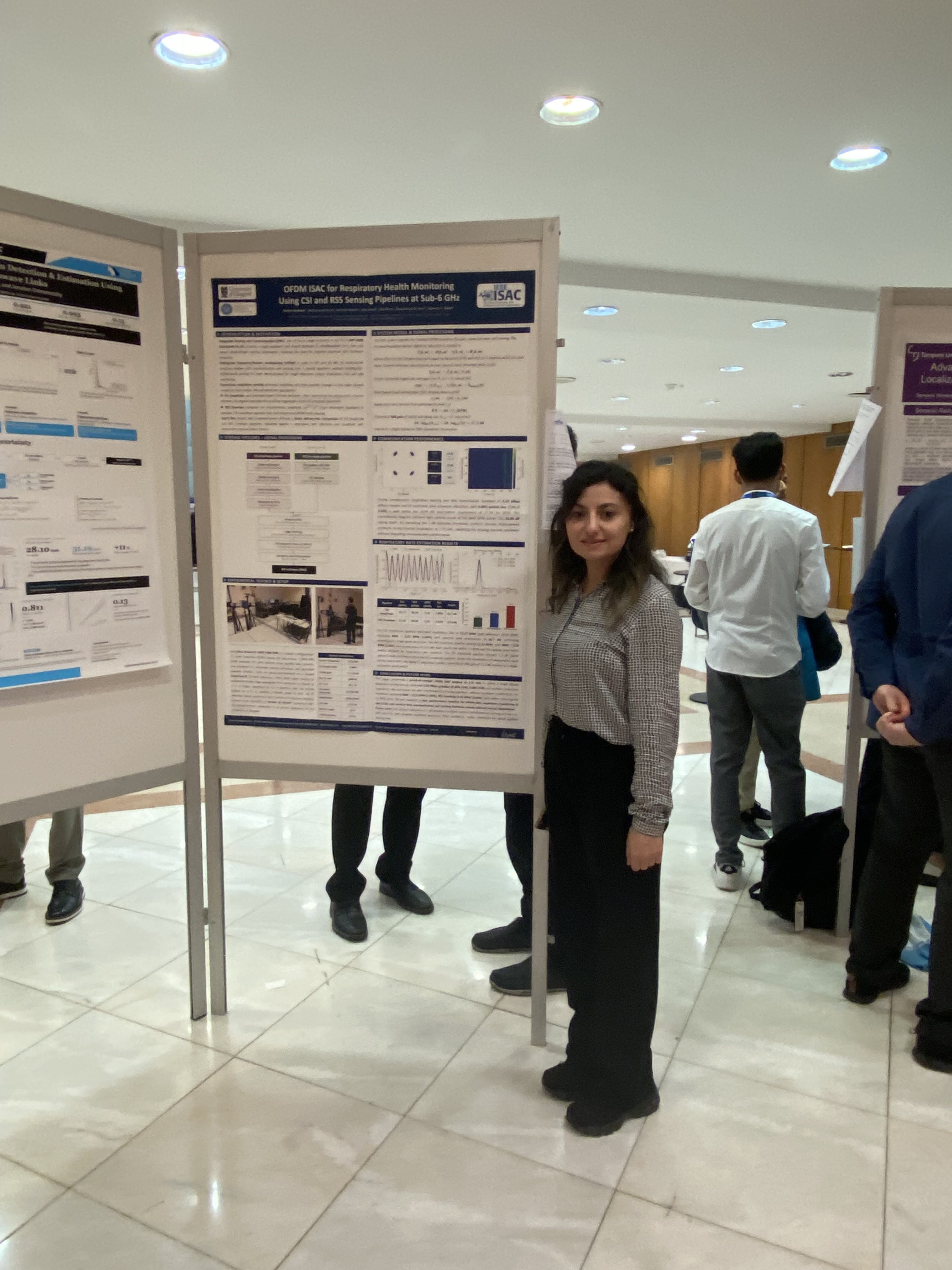
Representing the University of Glasgow, Dr Siber Unaldi, a postdoctoral researcher working with Professor Qammer H. Abbasi, is presenting two papers on the practical applications and technical challenges of integrated sensing and communications (ISAC).
Using wireless signals to monitor respiratory health
The first paper, “OFDM ISAC for Respiratory Health Monitoring Using CSI and RSS Sensing Pipelines at Sub-6 GHz,”examines how wireless communication signals can monitor respiratory activity.
By examining Channel State Information (CSI) and Received Signal Strength (RSS), the research investigates how to extract breathing-pattern information from wireless signals.
The findings contribute to contactless health-monitoring technologies, demonstrating how communication infrastructure can support sensing applications alongside conventional data transmission.
Improving resilience in intelligent wireless environments
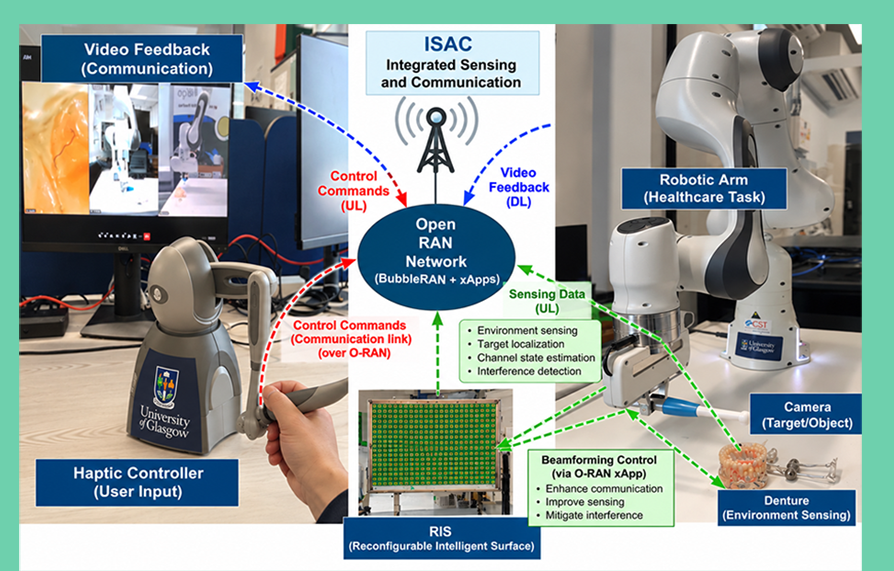
The second paper, “EMI-Resilient RIS-Assisted ISAC: Integrated Communication-Localization Tradeoff Analysis,”explores how Reconfigurable Intelligent Surfaces (RIS) can help bring communication and localisation together.
The research investigates the impact of electromagnetic interference (EMI) and the trade-offs between communication performance and localisation accuracy.
Understanding these challenges is essential to developing reliable wireless systems that can operate in complex, interference-prone environments.
Strengthening security in integrated sensing and communications
Also attending IEEE ISAC 2026 are Dr Michael Breza and Yinchao Yang from Imperial College London’s research team.
Yinchao Yang is presenting the paper “Dual-Security for Indoor OFDM-ISAC Systems via Temporal Artificial Noise,”co-authored with Yathreb Bouazizi, Prabhat Raj Gautam, Michael Breza and Professor Julie A. McCann.
The research investigates how temporal artificial noise can improve security in systems that combine wireless communications and sensing, helping to protect both communication data and sensing information from unauthorised access.
This work addresses an important challenge for future integrated networks: ensuring that the ability to sense the surrounding environment does not introduce new security vulnerabilities.
Advancing CHEDDAR’s vision for future networks
Together, these three papers demonstrate the breadth of CHEDDAR’s research into integrated sensing and communications, from contactless healthcare applications and interference-resilient systems to wireless security.
The contributions also align with CHEDDAR’s next research vision, Cognizant Convergent Connectivity, which aims to integrate communications, sensing, computing and energy within intelligent, adaptive and resource-efficient network infrastructures.
Through collaboration across its partner universities, CHEDDAR continues to investigate the technologies and architectures needed to support the next generation of connected services.
Find out more: IEEE ISAC 2026