CHEDDAR researchers develop breakthrough technology to help future 6G networks overcome interference
23 Jul, 2026
Researchers from the CHEDDAR Hub at the University of Glasgow have developed a new approach that could improve the reliability, security and energy efficiency of future 6G communications networks.
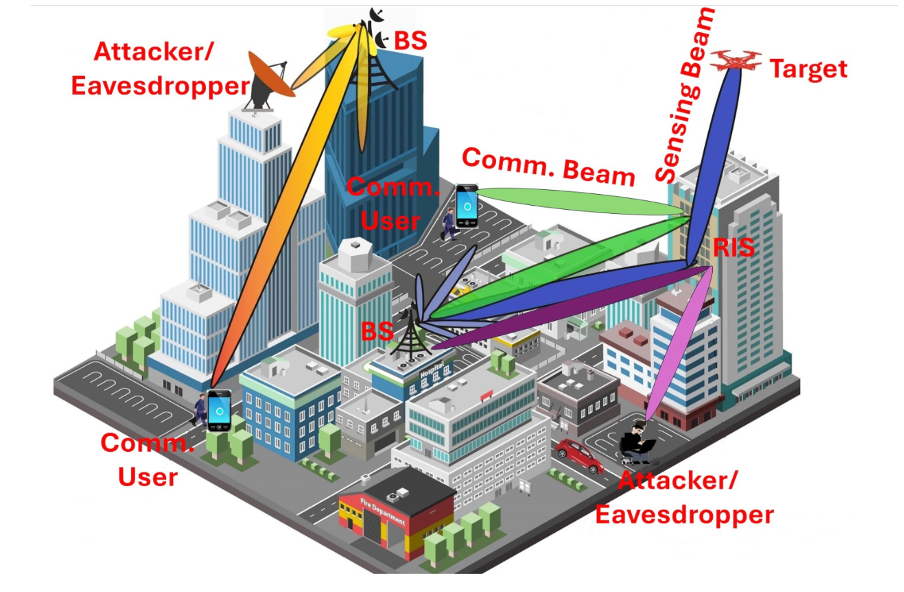
The breakthrough addresses a major challenge facing reconfigurable intelligent surfaces, or RIS smart surfaces that can manipulate and redirect wireless signals to improve connectivity, sensing and positioning.
Led by researchers at the University of Glasgow’s James Watt School of Engineering, the team has developed an electromagnetic interference-aware framework that enables RIS technology to distinguish between intended wireless signals and unwanted interference.
The research could support the development of more secure and resilient integrated sensing and communications systems for future applications including connected healthcare, autonomous transport, intelligent infrastructure and smart cities.
Tackling interference in an increasingly connected world
The growing number of connected phones, computers, vehicles, wearable devices and machines is contributing to rising levels of electromagnetic interference, or EMI.
This interference creates constant background noise that can make it more difficult for wireless devices to communicate clearly and accurately.
RIS technology offers a promising solution. These programmable surfaces contain thousands of individual elements capable of reflecting, focusing and redirecting electromagnetic waves towards specific users.
Saber Hassouna, Research Associate at the University of Glasgow’s James Watt School of Engineering and first author of the paper, explained:
“A reconfigurable intelligent surface is like a mirror. When sunlight hits a mirror in your hand, you can tilt it to send the light towards the area you choose. RIS does the same thing with wireless signals.
“Instead of reflecting radio waves randomly, it intelligently concentrates the energy on the areas intended to receive it.”
Directing signals only towards intended users can also provide an important security benefit by making communications more difficult for unauthorised users to intercept.
However, existing RIS systems can reflect and amplify interference alongside the intended signal, potentially reducing data-transfer speeds and limiting the accuracy of positioning systems.
An EMI-aware intelligent surface
Rather than attempting to cancel interference after it reaches the network, the CHEDDAR researchers developed a framework that identifies and filters interference while preserving the strength of the desired signal.
The approach analyses the unique statistical “fingerprint” of the interference and conducts a sweep of potential beam directions to identify the strongest signal.
This information is then incorporated into the algorithm controlling the RIS, enabling the surface to direct wireless energy more accurately and effectively.
Jalil Kazim, a co-author of the paper and researcher at the James Watt School of Engineering, said:
“Previously, cancelling out this kind of interference meant the base station had to do a huge amount of intensive digital signal processing, and that computation is expensive in energy terms.
“By placing an intelligent surface in the environment, we can shape the signal path in a way that helps handle the interference before it ever reaches the base station. That eases both the computational burden and the energy cost on the network itself.”
Successfully demonstrated in the laboratory
The team tested the EMI-aware framework using a reconfigurable intelligent surface containing more than 4,000 programmable elements arranged in a 64-by-64 grid.
Software-defined radios generated signals at 3.5 GHz, a frequency currently used by 5G communications networks.
Five users were positioned around the test environment. Three legitimate users were located inside the laboratory, while two users were positioned in a corridor outside to represent potential eavesdroppers.
Guided by the new algorithm, the RIS successfully concentrated wireless energy towards the three authorised users while preventing the two potential eavesdroppers from receiving a usable communications signal.
The experimental results closely matched the team’s simulations, demonstrating significant improvements in data rates and accurate user localisation even in the presence of electromagnetic interference.
Professor Muhammad Ali Imran, Head of the James Watt School of Engineering and a co-author of the paper, said:
“Security, privacy and resilience are no longer optional extras in these networks but essential requirements.
“Our surface can direct the signal towards the users we trust and deny it to the ones we don’t, bringing us closer to the secure, flexible networks which will define the communications and sensing technologies of tomorrow.”
Supporting secure and sustainable 6G networks
The research contributes to CHEDDAR’s wider work to develop intelligent, sustainable and human-centred communications infrastructure for future networks.
Professor Qammer Abbasi, corresponding and lead author of the paper, said:
“This work demonstrates how intelligent wireless environments can become an active part of the network, rather than simply reflecting signals.
“By making reconfigurable intelligent surfaces aware of their electromagnetic environment, we are not only improving connectivity but also strengthening security, reducing energy consumption and enabling the reliable operation of future applications such as connected healthcare, autonomous systems and smart cities.
“This is an important step towards AI-native 6G networks that can intelligently adapt to the real world while delivering tangible societal and economic benefits.”
Professor Abbasi is also Director of the University of Glasgow’s Centre for Integrated Sensing, Communication and Computing for Cognitive Cities, known as ISAC³, which was launched in February 2026 to support the development of future cognitive cities.
Researchers from King Fahd University and the University of Leicester also contributed to the study.
The paper, “Integrated EMI-Aware RIS Framework for Robust Communication and Localization: Simulation and Experimental Evaluation,” has been published in the IEEE Journal of Selected Topics in Electromagnetics, Antennas and Propagation.
The research was supported by UK Research and Innovation’s Engineering and Physical Sciences Research Council and the Ibn Battuta Global Scholarship Program.
Congratulations to Professor Qammer Abbasi, Saber Hassouna, Jalil Kazim, Professor Muhammad Ali Imran and all the researchers involved in this important achievement.