CHEDDAR advances AI-native network research at FYUZ 2026 in Seattle
12 Nov, 2026
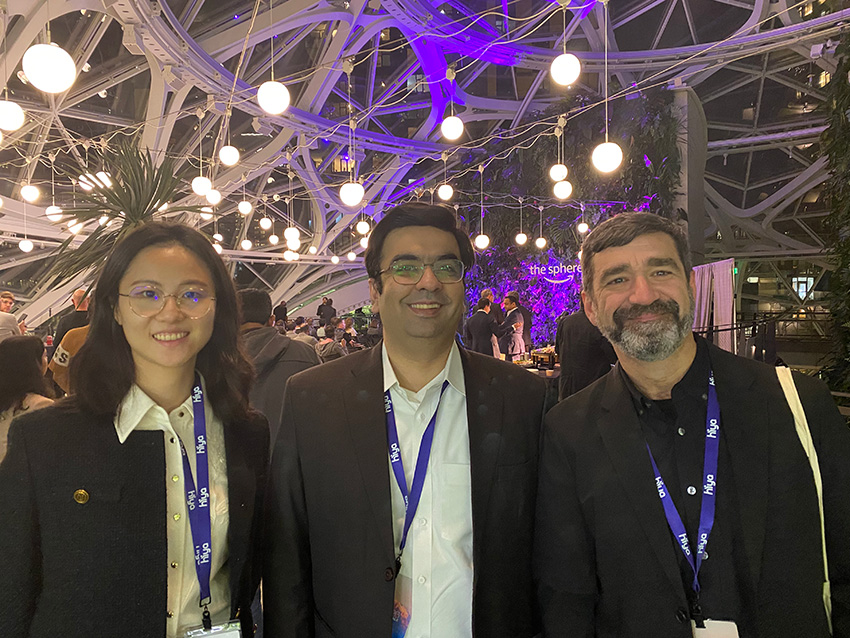
CHEDDAR researchers joined global telecoms leaders at FYUZ 2026 in Seattle, contributing to advances in federated AI, autonomous networks and integrated sensing and communications (ISAC), and showcasing research that could help shape the next generation of connectivity.
Held from 1–5 November 2026, FYUZ 2026 and the AWS Breaking Barriers Hackathon brought together network operators, technology companies and academic researchers to address some of the industry’s most pressing challenges.
Organised by the Telecom Infra Project (TIP), FYUZ provided CHEDDAR researchers with an opportunity to collaborate with industry partners, contribute to emerging AI-native network technologies, and explore how research can support the deployment of more intelligent, secure, and sustainable networks.
CHEDDAR researchers contribute to AI-native network innovation
A key focus of CHEDDAR’s participation was the development of the Network Language Model (NLM) Substrate, part of a first-of-a-kind initiative led by AWS, TELUS, AT&T and other industry partners.
Researchers from the University of Leeds and the University of Surrey contributed to work on the NLM Substrate and federated learning approaches, which enable multiple network operators to collaboratively train AI models without sharing sensitive operational data.
This approach could help improve network intelligence while addressing the privacy and security challenges associated with sharing data between operators.
Leeds researchers take on AWS Breaking Barriers Hackathon
Three teams from the University of Leeds brought their research expertise to the AWS Breaking Barriers Hackathon, tackling practical challenges in AI, network intelligence and connectivity.
- Telecom Decision Model: Dr Yejing Fan led a hybrid all-female team, alongside Shehr Bano, to develop a first-of-its-kind Telecom Decision Model.
- Federated AI for telecoms: Dr Abdel Aziz Salama and Dr David Naseh developed a federated learning implementation for NLM training, integrated into the OpenAirInterface stack.
- Terrestrial and non-terrestrial network integration: Dr Mohammad Hamed and Ahmed Chyad developed a digital twin-based approach for integrating terrestrial and non-terrestrial networks (TN-NTN).
The hackathon provided an opportunity to explore how emerging research can be applied to real-world telecoms challenges, bringing academic expertise into direct engagement with industry-driven innovation.
Bringing academic research into industry discussions
CHEDDAR researchers also contributed to discussions on the future of intelligent and increasingly autonomous networks.
Professor Syed Ali Zaidi and Professor Chuan Foh joined a panel of leading researchers to share academic perspectives on the technical opportunities and challenges of developing AI-native network infrastructure.
Meanwhile, Tom Rumbelow, CHEDDAR’s Head of Policy and Strategy, took part in a panel discussion on Integrated Sensing and Communications (ISAC) alongside major network operators, technology vendors and US government representatives.
The discussion examined the potential for ISAC to support new applications and services, as well as the technical and commercial challenges that must be addressed before the technology can move from research environments into widespread deployment.
Reflecting on the importance of maintaining close relationships with industry, Tom Rumbelow said:
“It was great to represent CHEDDAR in a very industry-focused environment. Keeping that dialogue open keeps us focused on where the problems and demands are from industry that we can solve, while promoting to them the world-leading research we’re conducting across the Hub.”

Professor Syed Ali Zaidi, Professor Chuan Foh and Tom Rumbelow
Industry discussions highlight priorities for future networks
Discussions throughout FYUZ reinforced the growing momentum behind AI-native telecommunications, as operators moved beyond early concepts towards the practical requirements of deploying intelligent and autonomous networks.
Several priorities emerged, closely aligning with CHEDDAR’s research:
- AI-native network infrastructure: Operators are increasingly focusing on the data architectures and AI capabilities needed to optimise network performance and operations.
- Safe and responsible autonomy: Achieving Level 4 network autonomy will require careful consideration of resilience, security, safety and sustainability.
- Agentic AI and orchestration: Different network functions will require tailored approaches to intelligent agents, coordination and decision-making.
- Synthetic data: Generating high-quality training data, including representations of rare but critical events, will be essential for reliable AI performance.
- ISAC and physical AI: Integrated sensing could unlock new applications in physical AI, although challenges remain in translating laboratory research into operational deployments and integrating sensing into the radio access network (RAN).
- New commercial opportunities: Developments in AI infrastructure, network intelligence and emerging service models could create new revenue opportunities for telecoms operators.
The discussions also highlighted the importance of managing data location, latency and infrastructure requirements, potentially creating opportunities for shared AI and RAN infrastructure.
Connecting industry priorities with CHEDDAR’s next phase
The themes emerging from FYUZ closely reflect the research direction of CHEDDAR’s next phase, Cognizant Convergent Connectivity.
This approach seeks to bring communications, sensing, computing and energy together within a unified, intelligent and adaptable network infrastructure.
Rather than treating these capabilities as separate technologies, CHEDDAR is exploring how they can operate together, supported by AI-native intelligence, to respond dynamically to changing network conditions and service requirements.
Research into federated intelligence, agentic autonomy, ISAC and physical AI will play an important role in this work, helping to bridge the gap between individual technology demonstrations and integrated, deployable solutions.
For the UK telecoms ecosystem, this creates opportunities to strengthen collaboration between universities and industry, accelerate technology development and support the commercialisation of advanced connectivity research.
What’s next for CHEDDAR?
During FYUZ, the CHEDDAR team also recorded a studio discussion outlining the programme’s future research priorities and ambitions.
The recording will provide further insight into how CHEDDAR intends to build on its existing research and partnerships to address the challenges facing future intelligent networks.