
VariSAC: V2X Sustained Connectivity in RIS-Aided ISAC via GNN-Augmented Reinforcement Learning
Vehicular networks place far higher demands on the continuity of connectivity than everyday communication services. Vehicles move at high speed, sensing and safety messages carry strict deadlines, and even brief fluctuations in link quality can make the information unreliable. Vehicular ISAC (Integrated Sensing and Communication) scenarios therefore require continuous connectivity from the network.
Our VariSAC framework addresses this in two ways. First, it introduces a new metric, the Continuous Connectivity Ratio (CCR), which quantifies the continuous connectivity of the network. Second, it uses artificial intelligence methods a graph neural network combined with reinforcement learning to automatically manage network resources, including channel allocation, power control and the configuration of reconfigurable intelligent surfaces (RIS), to meet the continuous connectivity requirements of vehicular networks.
The connectivity challenge
High-level autonomous vehicles carry a large number of sensors, generating raw data at multi-gigabit-per-second rates. Autonomous driving and cooperative perception require vehicles to exchange information continuously with infrastructure and with other vehicles. Intermittent connectivity creates temporal gaps in the information flow and directly degrades the quality of perception fusion.
Existing communication standards define metrics such as transmission rate and single-transmission success probability. Service continuity is addressed only qualitatively, and no metric quantifies how reliably a connection is sustained across consecutive time slots. This research fills that gap.
How VariSAC works
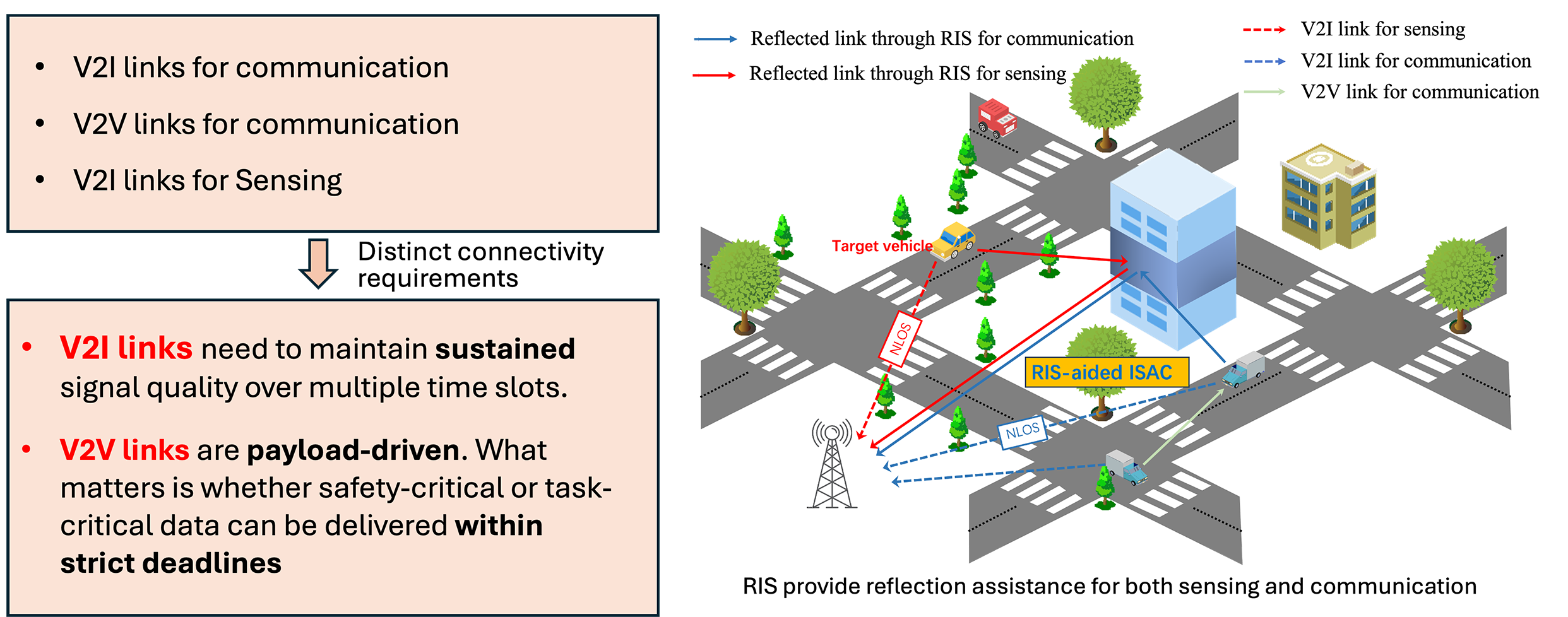
The first innovation is the new Continuous Connectivity Ratio metric. Vehicle-to-infrastructure (V2I) links require signal quality to remain above specified thresholds over consecutive time slots, while vehicle-to-vehicle (V2V) links require safety messages to be delivered within strict deadlines.
The two link types therefore define reliability differently. CCR unifies both requirements within a single optimisable metric: the temporal continuity of V2I links is modelled using a sliding time window, while the reliability of V2V links is captured by the probability of delivery within the deadline.
The second innovation is an optimisation method combining graph neural networks and reinforcement learning. The graph neural network captures the spatial structure of the network, while reinforcement learning makes resource-management decisions across time.
Why this research matters
ISAC is one of the core directions for the development of 6G, and this work provides a reference framework for managing resources within these networks.
The research also has important implications for road safety. Cooperative perception, vehicle platooning and remote driving all depend on sustained connectivity and the continuous exchange of timely, reliable information between vehicles and infrastructure.
“Guaranteeing instantaneous connectivity is a fundamental capability of any network. Guaranteeing continuous connectivity in highly dynamic scenarios such as vehicular networks is the higher requirement facing next-generation networks. VariSAC turns continuous connectivity in vehicular networks into a measurable and optimisable objective.”
Relevance to UK policy
Self-driving vehicles are a direction that the UK government is actively advancing. In June 2025, the government confirmed that, from spring 2026, commercial firms would be able to pilot self-driving vehicles without a safety driver on England’s roads for the first time.
On 31 March 2026, the Centre for Connected and Autonomous Vehicles (CCAV) and the Department for Transport (DfT) published guidance on the Self-Driving Vehicle Pilot Scheme. The Automated Vehicles Act 2024 is expected to come fully into force from the second half of 2027.
Deployment at scale requires supporting network infrastructure. Functions such as cooperative perception and remote monitoring depend on sustained, reliable connectivity between vehicles and infrastructure. This places continuous connectivity requirements on communication networks.
This research addresses that challenge and contributes to the technology base for the next-generation networks that will support the deployment of self-driving vehicles.
Next steps and collaboration
Testing and validation: The next step is to validate VariSAC using hardware platforms and in real-world road environments.
Collaboration: We welcome collaboration with automotive and telecommunications industry partners, as well as standardisation bodies, to bring the continuous connectivity metric and optimisation methods into practical systems.
A follow-on research programme exploring agentic resource management for vehicular networks is currently seeking funding support.
Key results
More than 15% improvement: Using real-world vehicle trajectory data, VariSAC improves the total continuous connectivity ratio by more than 15% compared with a greedy allocation strategy.
Consistent V2V connectivity: Across three real-world trajectory scenarios, the V2V payload connectivity ratio remains above 0.86 throughout.
Demonstrated scalability: When the number of vehicles increases from 12 to 20, the performance of the VariSAC method degrades by only 3.15%, compared with 14.24% and 14.52% for the two main baseline methods.
Related research
VariSAC draws on ideas explored across CHEDDAR’s wider research, including intelligent management of wireless resources, reconfigurable intelligent surfaces (RIS), integrated sensing and communication, and connectivity for moving vehicles. Explore these related papers for a closer look at the technologies and methods behind future V2X networks:
- Joint Optimisation based on Two-phase GNN in RIS- and DF-assisted MISO Systems with Fine-grained Rate Demands
- Multi-Agent Deep Reinforcement Learning-Based RIS-Aided UAV Communications
- Integrated EMI-Aware RIS Framework for Robust Communication and Localization
- Wideband Series-Fed Patch Antenna Array With High Gain and Low Sidelobe: Linearly and Circularly Polarized for 5G V2X Applications
- Federated MADDPG-Based Collaborative Scheduling Strategy in Vehicular Edge Computing