Beyond the 6G vision: CHEDDAR’s next phase of intelligent, converged connectivity
14 Oct, 2026

An IEEE Communications Society article co-authored by CHEDDAR Director Professor Julie McCann and Professor Muhammad Ali Imran explores the path from 6G research to practical deployment, a challenge now central to CHEDDAR 4’s research programme.
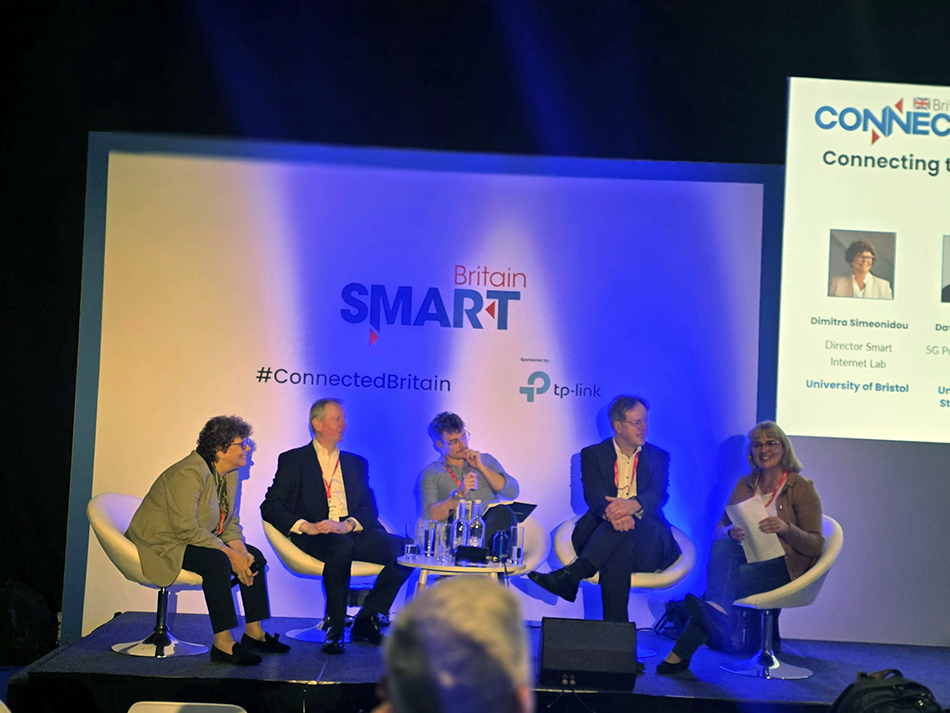
Drawing on the IEEE ICC 2026 Executive Forum in Glasgow, the article examines non-terrestrial networks, integrated sensing and communication, and AI-native networking. Professor McCann represented Imperial College London and the CHEDDAR Telecoms Hub on the panel.
The discussion emphasised that emerging technologies must demonstrate operational value, supported by realistic testing, standards and viable business models.
Cognizant Convergent Connectivity
CHEDDAR’s current direction builds on these challenges through Cognizant Convergent Connectivity: bringing communication, sensing, computation and energy together within infrastructure that can understand changing conditions and adapt its operation.
This combines two shifts. Convergence integrates functions that have traditionally been developed separately. Cognition introduces the intelligence needed to reason about network conditions, coordinate services and manage resources efficiently.
The ambition is to develop networks that do more than carry data: networks that support distributed intelligence, autonomous systems and interaction with the physical world.
Three missions connecting research with deployment
-
Converging sensing, computing, energy and communications
CHEDDAR is developing approaches that allow these functions to share wireless infrastructure and resources.
This includes integrated sensing and communication, over-the-air computation using wireless signals to help perform computational tasks and energy harvesting for low-power connected devices. The research aims to make these capabilities work together under realistic operating conditions.
Glasgow: exploring ISAC for healthcare
Research involving the University of Glasgow explores how wireless signals could support contactless respiratory disease screening. Using data from 220 participants, the study investigated whether reflected signals could distinguish between five respiratory conditions while retaining bandwidth for communication. It demonstrates a potential healthcare application of ISAC, with further validation needed before routine clinical use.
Read the respiratory sensing paper
Imperial: protecting ISAC against eavesdropping
Imperial College London researchers are investigating how to protect both communication and sensing information from unauthorised receivers. Their approach combines artificial noise with false sensing targets, known as “artificial ghosts”, which legitimate receivers can suppress. Numerical results show the potential to confuse eavesdroppers while maintaining authorised sensing and communication performance.
-
Developing resource-efficient, AI-native networks
The second mission focuses on frugal cloud infrastructure and AI-native radio access networks.
Telecom-specific AI, world models and AI agents will help turn network data into useful knowledge, supporting coordinated decisions and more autonomous operation. Resource efficiency is central: the benefits of intelligence must be assessed alongside its computing and energy demands.
-
Making autonomy trustworthy and practical
CHEDDAR’s third mission addresses Trusted and Cost-Aware AutonomyOps: the methods needed to validate, deploy and operate autonomous telecom systems.
The work brings together assurance, benchmarking, explainability and governance, helping establish whether systems can operate reliably across different technologies and suppliers, and at an acceptable cost. Security, privacy, resilience and sustainability run across all three missions.
Research includes wireless sensing to support preventative care, intelligent private networks for industrial control and condition monitoring, and resilient infrastructure for challenging environments.
Alongside technical development, CHEDDAR’s Design Imaginarium brings researchers together with operators, regulators, designers and the public to explore future needs and the societal implications of emerging technologies. This helps inform research requirements, deployment choices and policy guidance.
Working across the wider hubs ecosystem
The IEEE article highlights the contribution of the UK Federated Telecoms Hubs (FTH), including CHEDDAR, HASC and TITAN, alongside the JOINER national experimental platform.
CHEDDAR 4 develops this collaborative approach further through a joint strategy across the Future Connectivity Hubs (FCH), connecting research, infrastructure, skills and industrial engagement.
Within this strategy, the Hubs develop research, prototypes and intellectual property; FTH supports translation, commercialisation and standards engagement; and JOINER provides a proving ground for integrating and validating technologies under realistic conditions.
The aim is a clearer route from discovery to deployment, backed by evidence of performance, trustworthiness and practical value.
Authors of the IEEE article
- Muhammad Zeeshan Shakir, University of the West of Scotland, UK
- Muhammad Ali Imran, University of Glasgow, UK
- Julie A. McCann, Imperial College London and CHEDDAR Telecoms Hub, UK
- Harald Haas, University of Cambridge and TITAN Telecoms Hub, UK
- Wen Tong, Huawei Technologies
- Edward G. Tiedemann Jr, Qualcomm Technologies, USA
- Martin McKay, Vodafone Three, UK
Read 6G Beyond the Vision: Insights from ICC 2026 Executive Forum