Cranfield University Professor Showcases Breakthrough 6G NTN Resilient Architecture at IEEE SoftCOM 2026
7 Oct, 2026
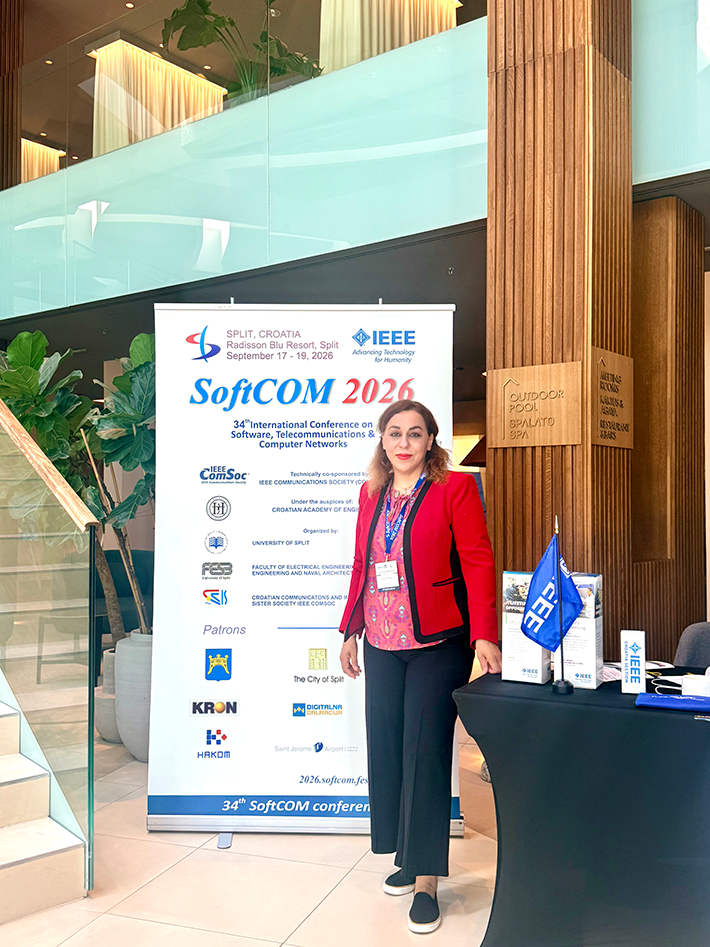
Professor Saba Al-Rubaye from Cranfield University has successfully demonstrated a pioneering 6G Non-Terrestrial Network (6G NTN) Resilient & Security system at the prestigious IEEE SoftCOM 2026 conference. Representing the CHEDDAR Hub (6G Future Communications Hub), the work drew significant interest and praise from international industry leaders and academic experts.
Bridging Aerial and Terrestrial Networks
The groundbreaking demonstration showcased a system designed for dynamic, flexible, and high-capacity communication across both aerial and terrestrial environments. By leveraging 6G core networks and Open RAN (ORAN) architecture, the CHEDDAR Hub’s framework smoothly links terrestrial networks (TN) and non-terrestrial domains using autonomous Unmanned Aerial Vehicles (UAVs).
Security at the Physical-Digital Intersection
While the system implements robust, multi-layer encrypted communication across the application, transport, and network layers to ensure payload security, the research also addresses critical vulnerability vectors. The team highlighted that external entities can still observe exposed metadata such as packet sizes, network handovers, and transition events, potentially enabling reconnaissance and inference of UAV states and network dependencies.
Years of Innovation in the Making
This highly anticipated framework is the culmination of several years of intensive research and development within the 6G Future Communications Hub (CHEDDAR). By bridging critical advancements across NTNs, cybersecurity, Open RAN, and UAV-based communications,
Professor Al-Rubaye’s work shines a spotlight on the critical security challenges of hybrid non-terrestrial networks, identifying vital vulnerabilities in metadata exposure while unlocking massive opportunities for highly resilient, multi-layer 6G architectures.