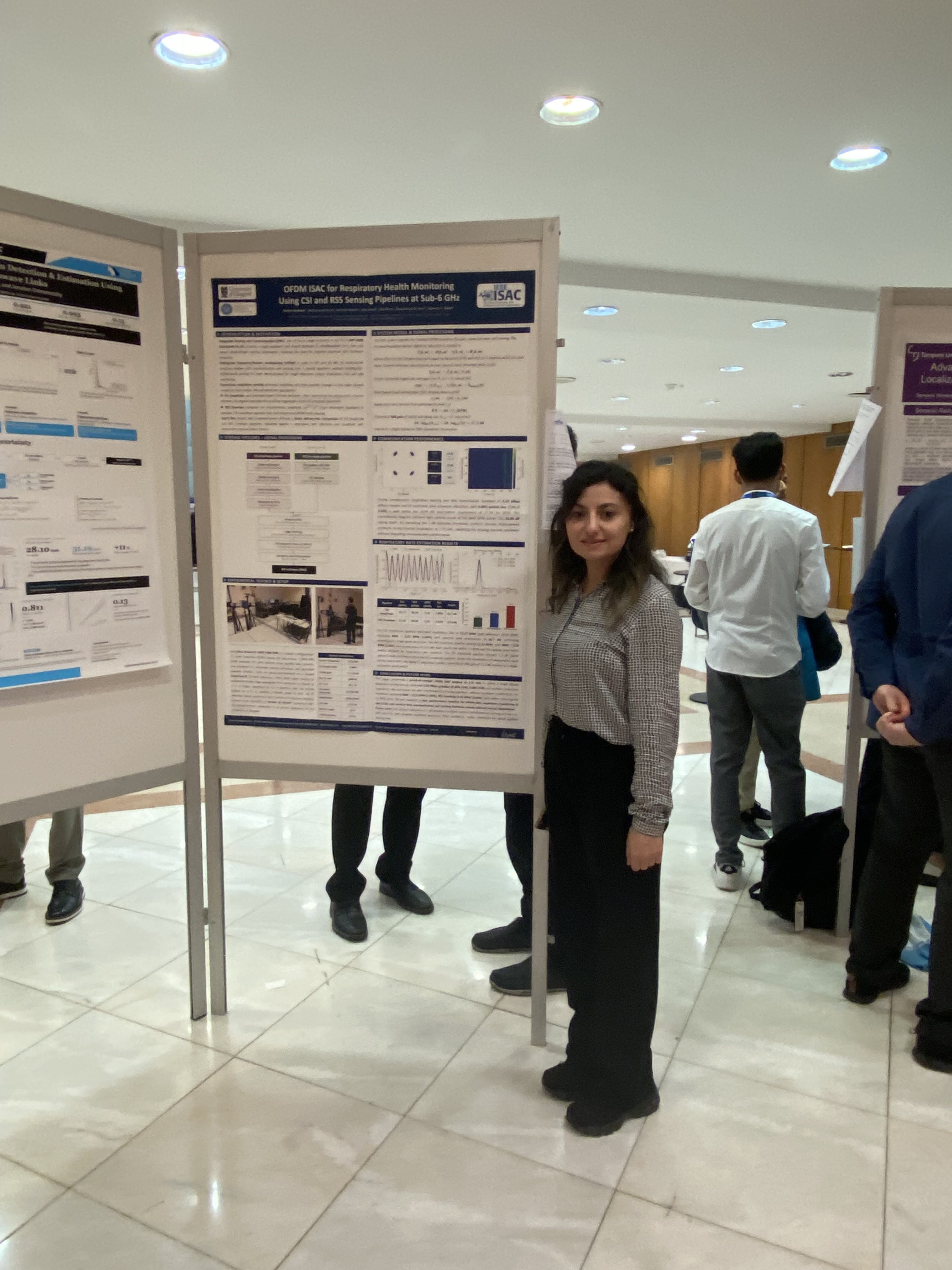
Dr Yinchao Yang presented research on how a wireless signal could protect data and preserve privacy in future wireless networks
19 Nov, 2026
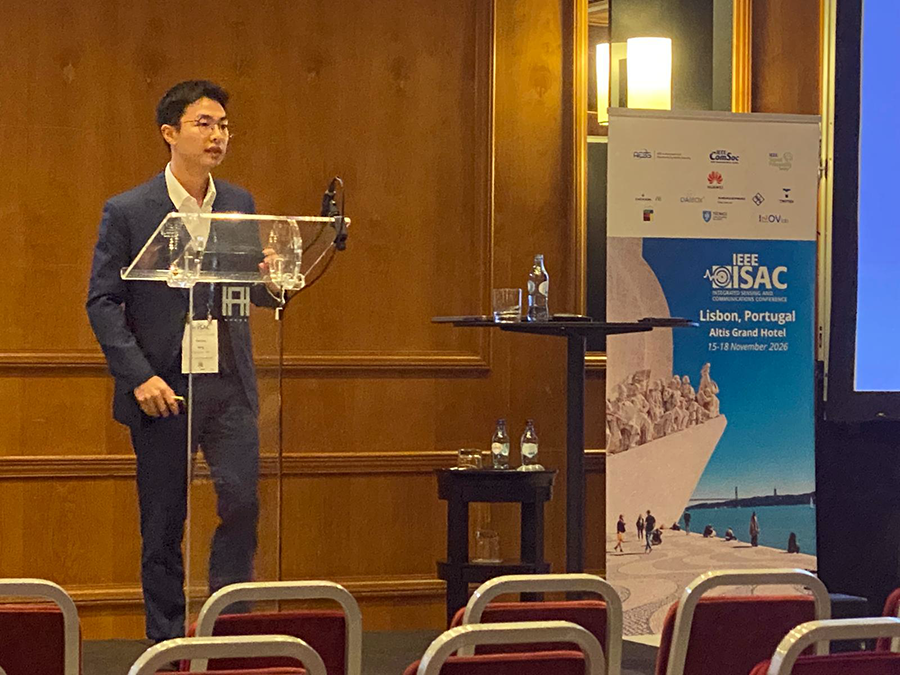
Dr Yinchao Yang from Imperial College London presented research at IEEE ISAC 2026 in Lisbon, showing how a single wireless signal could help protect both private communications and information about activity in indoor spaces.
Integrated sensing and communications (ISAC) allows wireless systems to send data while also using echoes from those same signals to sense their surroundings. Indoors, changes in how signals travel can provide helpful clues about objects and human activity. This can raise privacy concerns when people on the same network have access to different services. For example, a communications user might use the signal to sense their surroundings, while a sensing user might try to decode someone else’s data.
Dr Yang presented the study, Dual Security for Indoor FDM-ISAC Systems via Temporal Artificial Noise, at the IEEE Conference on Integrated Sensing and Communications, which took place 16-18 November 2026. He co-authored the work alongside Imperial colleagues Yathreb Bouazizi, Prabhat Raj Gautam, Michael Breza and Julie McCann.
How artificial noise can help protect both services effectively
The researchers explored a technique called temporal artificial noise, which adds a carefully designed component to the transmitted signal. This noise is shaped to cancel out during normal decoding by the authorised communications user. When the sensing user tries to decode the same data, though, the noise generally remains, making the message more difficult to recover.
For sensing, the technique makes use of the different reference signals available to each user. The authorised sensing user’s reference includes the artificial noise, helping it match the signal with the echo reflected from the target. In contrast, the communications user’s reference is based on the decoded data and excludes the noise. As a result, it’s more difficult for the communications user to estimate information about the target.
The design aims to balance four important outcomes: preserving signal quality for authorised communications, keeping authorised sensing accurate, and making unauthorised data decoding and sensing less effective. To achieve this, the researchers fine-tune how transmission power is shared between the data signal and artificial noise.
What the simulations showed
The simulations highlighted a trade-off between privacy protection and communication performance. Tighter limits on unauthorised decoding meant allocating more power to artificial noise, which reduced signal quality for the authorised user. Stricter protection against unauthorised sensing reduced signal quality further.
Authorised sensing accuracy remained fairly steady across the security settings tested at the study’s standard transmit power. When the researchers lowered the total transmit power, sensing error increased.
The study modelled a simplified indoor setting with one transmitter, one communications user, one sensing user, and one target. It also assumed the transmitter had perfect knowledge of the wireless channels. Future work will explore how the technique performs when that knowledge is incomplete and in more complex indoor environments where signals reflect and scatter.
As part of CHEDDAR’s research into future wireless networks, this study shows how carefully designing a shared signal can help protect two kinds of information at the same time. The research was supported by EPSRC through the CHEDDAR Hub, IntentMAPs, and the National Edge AI Hub.