
Over-the-Air Computation Enabling Integrated Communication, Sensing and Computation for 6G
11 Mar, 2026

Written by Professor Marco Di Renzo. Professor of Telecommunications Engineering, Kings College London
The Evolution Towards Connected Intelligence
Future networks are expected to go far beyond conventional communications of connected people and things, evolving into connected intelligence. Three additional usage scenarios will be fostered in 6G: integrated artificial intelligence and communications, integrated sensing and communications, and ubiquitous connectivity.
Integrating Communication, Sensing and Computation
These scenarios call for the fusion of the physical, biological, and cyber worlds, which naturally involves three core modules: communication for information sharing, sensing for information acquisition, and computation for information processing and decision-making. This integration, termed integrated communication, sensing and computation (ICSC), is essential for enabling the seamless operation of 6G networks.
ICSC represents a paradigm shift from traditional siloed approaches, where the three functions operate independently, to a unified framework that optimises resource utilisation and enhances system performance.
Addressing the Challenges of Massive Connectivity
The recent emergence and rapid evolution of ICSC have led to the proliferation of various intelligent services, imposing unprecedented demands for massive connectivity and fast data aggregation. However, limited radio resources and stringent latency requirements pose significant challenges in meeting these demands. In response, over-the-air computation (AirComp) has emerged.
How Over-the-Air Computation Works
The fundamental principle of AirComp is to harness the superposition property of the wireless multiple-access channel to achieve over-the-air aggregation of data concurrently transmitted from multiple devices. By seamlessly integrating communication, sensing, and computation procedures, as shown in the following figure:
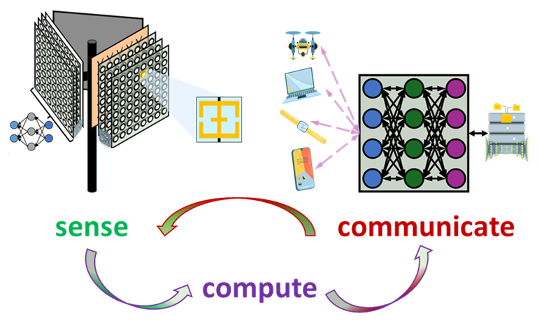
Seamlessly integrating communication, sensing, and computation procedures
AirComp enables “compute-when-communicate”, holding the potential for ultra-fast data aggregation even across massive wireless networks.
Advancing CHEDDAR’s Vision for Future Networks
Over-the-air computation is a fundamental enabler for CHEDDAR’s long-term vision of future communication networks in terms of enabling more efficient, distributed, and secure communication and computing network systems.
Within this context, the team at the Centre for Telecommunications Research at King’s College London, led by Professor Marco Di Renzo, is rethinking the fundamental design of communication networks by capitalising on AirComp-based communication, sensing, and computing algorithms.
A New Framework for ICSC Receivers
For example, the team has recently introduced a new framework to design ICSC receivers capable of simultaneously detecting data symbols and performing AirComp in a manner that:
▪ is systematically generalisable to a large class of functions
▪ scales to a massive number of users and edge devices
▪ supports the computation of multiple independent functions
▪ operates in a multi-access fashion whereby each transmitter can choose to transmit either data symbols, computing signals, or both
Demonstrating Scalability Through Simulation
With the aid of simulations, the team demonstrated that the proposed algorithms are scalable and can accommodate hundreds of antennas, users, and edge devices.
Further information can be found at:
https://arxiv.org/pdf/2506.05944